
Table of Contents [Hide]
Introduction
- The Hook: Traditional budgeting advice feels like a cruel joke when your inbox is flooded with minimum payment alerts. The popular 50/30/20 rule— popularized as the gold standard for personal finance—sounds great on paper: 50% for Needs, 30% for Wants, and 20% for Savings and Debt.
- The Problem: If high-interest credit cards, personal loans, or medical bills devour 35% or more of your take-home pay, standard math breaks down immediately. Trying to force a broken framework causes budget fatigue and leads to giving up entirely.
- The Solution: You don’t need to throw out the 50/30/20 framework—you need to recalibrate it for active debt recovery.
Why the Standard 50/30/20 Rule Fails Debt-Heavy Budgets
- The Original Breakdown:
- 50% Needs: Rent/mortgage, utilities, basic groceries, minimum required payments.
- 30% Wants: Dining out, subscriptions, hobbies, entertainment.
- 20% Savings & Accelerated Debt: Emergency fund, retirement, extra principal debt payments.
- The Mathematical Reality Check: When high-interest minimum payments take up 30% of your paycheck, your “Needs” category swells to 70% or 80%. If you try to keep spending 30% on “Wants,” you go into negative cash flow every month, pulling out credit cards to bridge the gap and worsening the cycle.
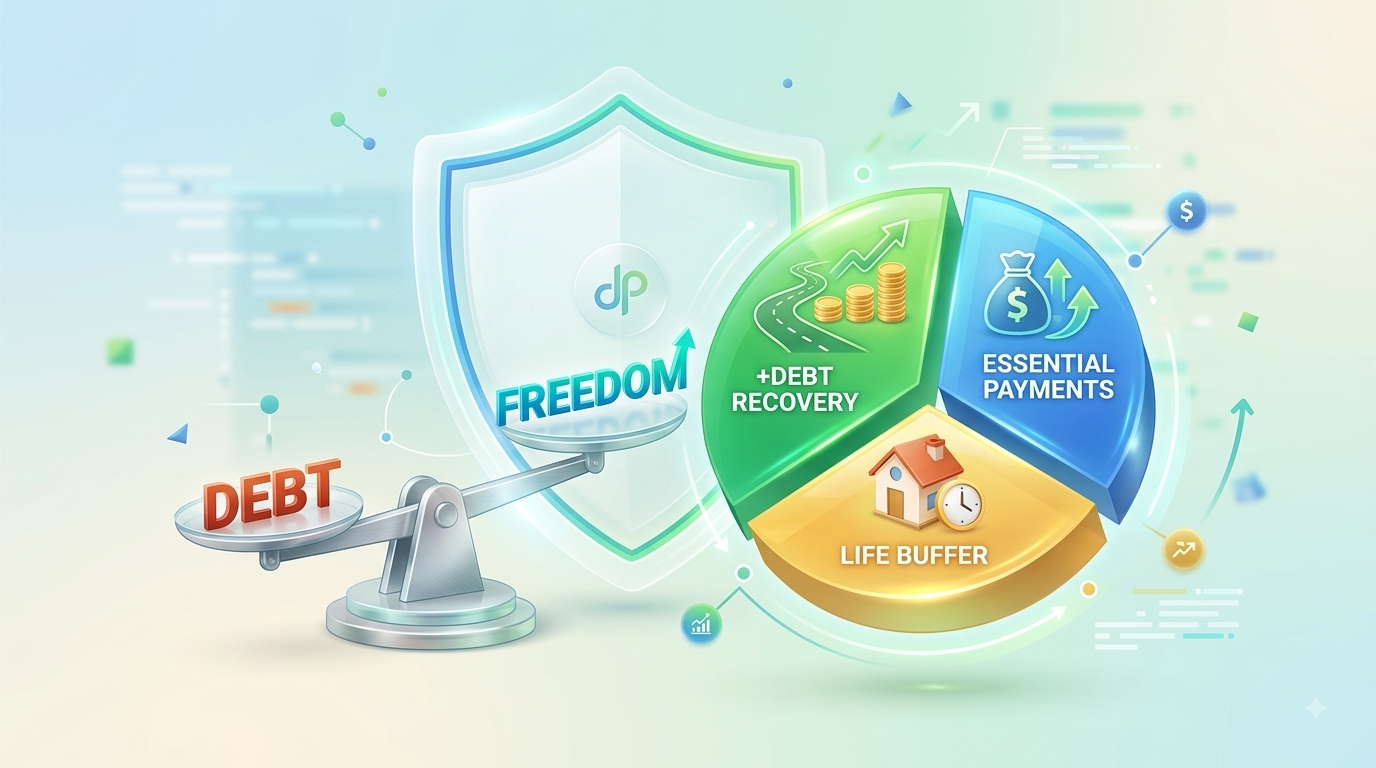
The “70/20/10 Debt-First” Modified Framework
To break free, you must temporarily adjust your percentages until your high-interest debt reaches zero:
- 70% Essentials & Minimum Commitments (Survival Layer):
- Housing, basic groceries, utilities, transportation to work, and all minimum contractual debt payments.
- Rule: Zero luxury spending fits here.
- 20% Accelerated Debt Payoff (The Hammer):
- Every single dollar in this bucket goes directly toward one target balance (using either the Debt Avalanche or Debt Snowball method).
- Do not split this money across multiple accounts; concentrate the fire.
- 10% Flexible Life / Anti-Burnout Buffer (The Sanity Layer):
- Strict frugality without a release valve causes budget relapse. Use this 10% for small comforts, minor entertainment, or unexpected non-emergency micro-expenses.
Step-by-Step Transition Guide
- Audit Your Baseline (The Hard Truth): Pull 90 days of bank statements to calculate your exact current percentage distribution.
- Freeze the “Wants” Bleed: Identify subscription auto-renews, food delivery apps, and impulse buys. Slash them immediately to free up cash for the 20% Debt Hammer.
- Build a $1,000 Starter Buffer First: Before throwing full force into the 20% debt bucket, pause and stockpile $1,000 in cash to prevent new credit card swipes when minor emergencies pop up.
- Automate the 20% Allocation: Set up automatic transfers on payday directly toward your priority debt balance so you never see or spend that cash.
Section 4: Re-entering the Standard 50/30/20 Rule
- The Finish Line: The 70/20/10 modification is a temporary emergency protocol, not a lifelong sentence.
- Gradual Rebalancing: As individual cards or loans hit $0 balance, shift the money freed up from minimum payments straight into your retirement and long-term savings buckets until you reach the classic 50/30/20 balance.
Step-by-Step FAQ Section
- Q: Should I contribute to a 401(k) while using the 70/20/10 rule?
- A: Only contribute up to your employer’s match (free money). Pause contributions above the match until high-interest credit card debt (>10% APR) is eliminated.