
- The Mathematics of the Trap: Principal vs. Interest
- Case Study: A Tale of Two Repayments
- The Verdict:
- Mapping the Localization Gaps: US vs. UK Statements
- How to Break the Compound Interest Loop
- Step 1: Secure Your Starter Cash Buffer First
- Step 2: Implement the 4-Step Execution Hierarchy
- 🛡️ Professional Disclosure & Compliance Framework
- ⚖️ YMYL Financial Disclaimer
Let’s be completely honest: the minimum payment box on your monthly credit card statement is a financial illusion. It is not designed to help you clear what you owe. It is designed to do the exact opposite.
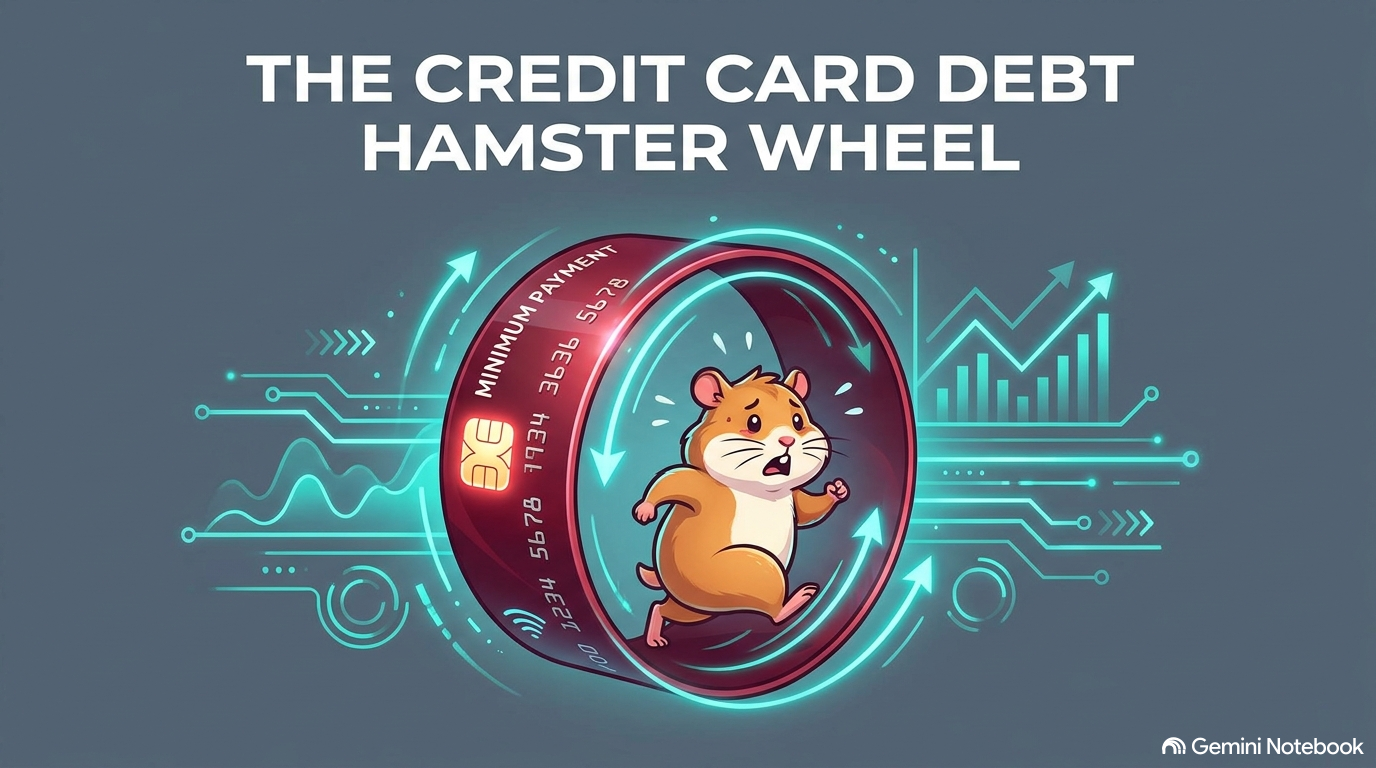
If you are currently treating that tiny, double-digit minimum payment as a convenient way to manage your cash flow, you aren’t actually paying off your debt. You are paying a lifetime tax to your bank [161, 193]. You are trapped on a financial hamster wheel that spins faster and faster, keeping you structurally skint while the bank’s shareholders enjoy record-breaking quarterly returns [158, 193].
Today, we are going to dismantle the math of this trap [161, 194]. We will look inside the credit card compound loop, expose the true danger of minimum payments, and map out a step-by-step escape route to claw back your cash flow once and for all [162, 198].
The Mathematics of the Trap: Principal vs. Interest
When you carry a balance on a credit card, every payment you make is split into two very different piles [161]:
- The Principal: This is the actual cash you borrowed to buy groceries, clothes, or that weekend getaway [161]. Reducing this pile is the only way to become debt-free [161].
- The Interest: This is the penalty fee the card issuer charges you for borrowing that money, calculated as an Annual Percentage Rate (APR) [161].
When you pay only the minimum required balance, the bank calculates that number using a sneaky formula—typically 1% to 2% of the total balance plus that month’s interest charges.
Because the minimum is pegged directly to your interest costs, the vast majority of your hard-earned cash is instantly eaten up by the APR [161]. Only a microscopic sliver of your payment actually touches the principal balance [161].
The next month, because your principal barely budged, you are charged interest on almost the exact same balance [161]. This is the compound interest loop—interest compounding on top of interest, month after month, year after year [158, 166].
       MONTHLY STATEMENT ARRIVES
                 │
                 v
   +---------------------------+
   |   MINIMUM PAYMENT MADE    |
   +---------------------------+
                 │
        ┌────────┴────────┐
        ▼                 ▼
+───────────────+   +───────────────+
|   INTEREST    |   |   PRINCIPAL   |
|   (90% - 95%) |   |   (5% - 10%)  |
| Goes to Bank  |   | Actual Debt   |
|  As Profit    |   |  Reduction    |
+───────────────+   +───────────────+
        │                 │
        └────────┬────────┘
                 ▼
     PRINCIPAL BARELY CHANGES
                 │
                 ▼
   NEXT MONTH'S INTEREST CALCULATED
        ON SAME HIGH BALANCE
Case Study: A Tale of Two Repayments
Let’s look at the raw, unfiltered math to see how this plays out in the real world.
Imagine you have a credit card with a balance of $5,000 (or £4,000) at an industry-average 24% APR [165]. Your minimum payment is calculated as 1% of the principal plus interest, starting at approximately $140 (or £110).
Here is what happens depending on your repayment strategy:
| Repayment Metric | Strategy A: Minimum Payments Only | Strategy B: Fixed $250 / £200 Monthly |
|---|---|---|
| Monthly Payment | Declines slowly (starts at $140/£110, drops to $30/£25) | Hard-coded at $250 / £200 every month |
| Time to WRECK the Debt | 23 Years and 8 Months | 2 Years and 1 Month |
| Total Principal Paid | $5,000 / £4,000 | $5,000 / £4,000 |
| Total Interest Paid | $7,840 / £6,270 | $1,385 / £1,110 |
| Total Cash Out of Pocket | $12,840 / £10,270 | $6,385 / £5,110 |
The Verdict:
By choosing Strategy A, you pay the bank more than double what you originally borrowed in interest alone [161, 166]! You spend nearly a quarter of a century paying for purchases that were likely thrown away, worn out, or forgotten decades ago.
By simply fixing your monthly payment at a flat, aggressive rate, you slash your timeline by over 21 years and save thousands in cold, hard cash [166].
Mapping the Localization Gaps: US vs. UK Statements
Depending on which side of the Atlantic you are managing your current or checking accounts in, regulatory authorities have forced banks to display warnings, but the underlying psychological triggers remain identical:
- 🇺🇸 The US Warning (FICO & Credit Card Act): Following the Credit Card Act of 2009, US statements must display a “Minimum Payment Warning” box. This table illustrates exactly how many years it will take to pay off your balance if you only pay the minimum, compared to a three-year fixed payoff plan. It also highlights the impact of carrying high balances on your FICO score via your Credit Utilization Ratio (the 30% rule) [178, 203].
- 🇬🇧 The UK Warning (Experian & FCA Regulation): The Financial Conduct Authority (FCA) mandates that UK credit statements feature a persistent warning box highlighting the long-term cost of minimum payments. Under “persistent debt” rules, if you pay more in fees and interest than principal over an 18-month period, UK lenders are legally required to contact you, suspend your card, and force you onto a structured, faster repayment schedule to protect your Experian credit rating [203].
How to Break the Compound Interest Loop
If you are ready to stop donating your income to major credit card companies, you must execute a systematic, non-negotiable strategy [162, 194].
Step 1: Secure Your Starter Cash Buffer First
Do not start aggressively overpaying your credit cards if your savings account is a dry desert [175, 193]. Why? Because the very moment your boiler packs up, your car breaks down, or you face a minor medical bill, you will be forced to whip out your credit card, instantly undoing all your hard work [194, 197].
- Establish a $1,000 (or £1,000) starter safety buffer in a separate high-yield account before you throw an extra penny at your debt principal [175, 194, 197].
Step 2: Implement the 4-Step Execution Hierarchy
Once your starter cash buffer is secure, transition your repayment strategy from a random, uncoordinated mess into an automated, targeted attack [159, 162, 194]:
- List Your Debts: Write down every credit card, personal loan, and store card with their balance, APR, and minimum payment [162, 198].
- Order Your Attack: Choose your system [162, 198]:
- The Debt Avalanche: Order by highest interest rate (APR) to save the maximum amount of money [163, 198].
- The Debt Snowball: Order by smallest balance size to gain rapid, psychological momentum [168, 198].
- Automate Your Minimums: Set up automatic monthly payments for every single card on your list except the one at the very top of your target hierarchy [162, 173].
- Channel All Spare Cash Flow: Direct every extra dollar or pound from your budget, along with digital round-ups [197], straight toward your top target debt until it is completely demolished [162].
Once that first target balance hits absolute zero, celebrate the psychological win [170]! Then, roll that card’s entire minimum payment, plus your extra cash flow, directly into your second target debt [162]. This rolling mechanism creates a massive compound snowball, allowing you to slice through your balances with accelerating speed [163].
🛡️ Professional Disclosure & Compliance Framework
⚖️ YMYL Financial Disclaimer
Disclaimer: DebtPave provides free, educational personal finance and debt reduction resources to help you build long-term financial literacy. We are not certified financial planners, registered investment advisors, or legal experts. Every financial situation is unique. Always consult with a qualified, registered professional before making major financial decisions or restructuring your personal liabilities.