
- Introduction: Taking Control of Your Financial Life
- Understanding the Mechanics of Debt Payoff
- Strategy 1: The Debt Avalanche Method (Maximum Savings)
- Strategy 2: The Debt Snowball Method (Maximum Motivation)
- Side-by-Side Strategy Comparison
- How to Choose the Right Strategy for Your Situation
- Advanced Tips to Accelerate Your Debt Payoff
- Frequently Asked Questions (FAQ)
- Final Thoughts
Introduction: Taking Control of Your Financial Life
Living under the weight of accumulated debt is one of the most stressful financial situations anyone can experience. Whether it is high-interest credit card balances, personal loans, or medical bills, watching interest charges pile up month after month can make you feel like you are running on an endless financial treadmill.
Taking the first step toward becoming debt-free requires more than just good intentions—it requires a proven, repeatable strategy. Simply throwing random amounts of money at various accounts whenever you have extra cash rarely yields long-term results. Without a structured framework, high interest rates quickly swallow up your payments, leaving your principal balances virtually untouched.
Fortunately, personal finance experts and financial advisors widely agree on two highly effective frameworks for systematic debt elimination: The Debt Avalanche and The Debt Snowball.
While both methods require making minimum payments on all your obligations while directing extra cash toward a single target debt, they approach the task from completely different angles. One method prioritizes strict mathematical efficiency to minimize total interest paid, while the other leverages behavioral psychology to build early momentum through quick wins.
In this comprehensive guide, we will break down exactly how both strategies work, compare their pros and cons side-by-side, explore real-world scenarios, and help you determine which approach aligns best with your mindset and financial goals.
Understanding the Mechanics of Debt Payoff
Before diving into the specifics of each method, it is crucial to understand the foundational principle behind systematic debt reduction.
When you carry multiple balances across credit cards and personal loans, your monthly payments are split between two components:
- Principal: The actual balance you borrowed.
- Interest: The fee charged by the lender for borrowing that money, calculated as an Annual Percentage Rate (APR).
When you only make minimum payments, the vast majority of your money goes toward interest charges. To break this cycle, you must create a structured payment hierarchy.
Both the Debt Avalanche and Debt Snowball methods use a focused, four-step execution process:
- Step 1: List every single debt you owe, including the total balance, current interest rate (APR), and required minimum monthly payment.
- Step 2: Order your list according to the specific rules of your chosen strategy (by interest rate or by balance size).
- Step 3: Set up automatic minimum monthly payments for every debt on your list except the one at the top.
- Step 4: Throw every single extra dollar from your budget toward the top debt until its balance hits zero, then roll that entire payment amount over to attack the next debt.
This rolling payment mechanism creates a snowballing effect over time, accelerating your progress with every debt you eliminate.
Strategy 1: The Debt Avalanche Method (Maximum Savings)
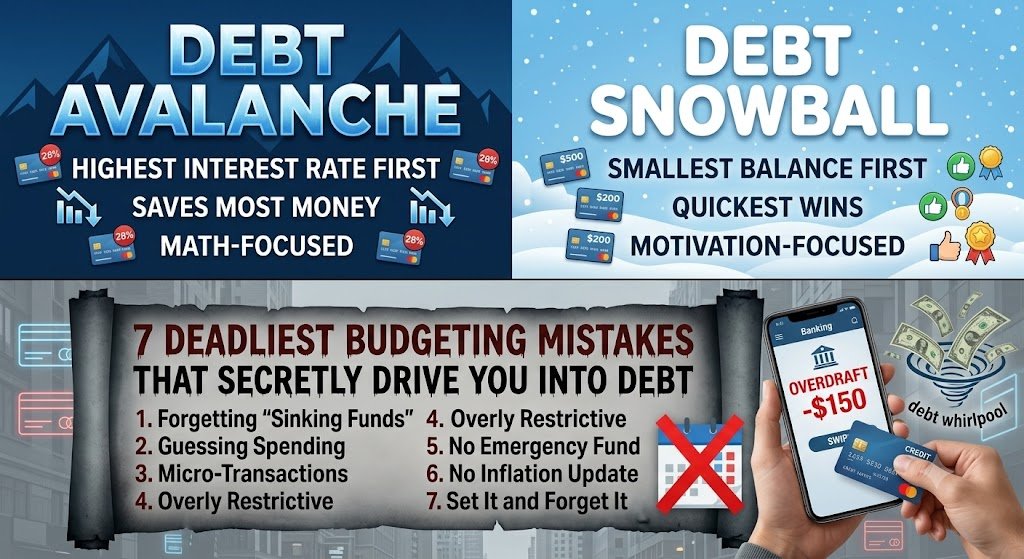
The Debt Avalanche strategy is the mathematically optimal path to debt freedom. Its primary objective is simple: reduce the total amount of interest paid to lenders over the lifetime of your debt payoff journey.
How the Debt Avalanche Works
Under the Debt Avalanche method, you organize your debts strictly by interest rate (APR), from highest to lowest. You completely ignore the total balance owed on each card or loan.
- Identify the debt with the highest interest rate (for example, a store credit card charging 29.99% APR).
- Allocate every extra available dollar in your monthly budget to pay down this high-interest account.
- Continue making minimum required payments on all other lower-interest accounts.
- Once the highest-interest balance is fully cleared, redirect its entire monthly payment—plus your extra budget funds—toward the debt with the second-highest APR.
Real-World Example of the Debt Avalanche
Imagine you have three debts:
- Card A: $8,000 balance at 28% APR (Minimum payment: $200)
- Card B: $2,000 balance at 18% APR (Minimum payment: $50)
- Personal Loan C: $500 balance at 10% APR (Minimum payment: $25)
With $300 in extra monthly cash, your target order under the Debt Avalanche is Card A first, because 28% APR is charging you the most money in interest every single day. Even though Card C has the smallest balance ($500), it sits at the bottom of the list because its 10% interest rate is much less damaging to your total net worth.
Advantages of the Debt Avalanche
- Saves the Maximum Amount of Money: By eliminating high APR accounts first, you stop financial hemorrhaging and save hundreds or even thousands of dollars in compound interest.
- Shortens Total Payoff Time: Less money wasted on interest charges means more of your cash actively reduces principal, leading to a faster overall payoff date.
- Logical and Efficient: Perfect for analytical individuals who like optimization and numerical precision.
Drawbacks of the Debt Avalanche
- Delayed First Win: If your highest interest rate is attached to a large balance (like Card A’s $8,000 in the example above), it may take 8 to 12 months of consistent payments before you experience the satisfaction of closing an account.
- Requires High Discipline: Without quick initial victories, some individuals lose motivation and abandon the strategy mid-way.
Strategy 2: The Debt Snowball Method (Maximum Motivation)
The Debt Snowball strategy turns financial management on its head by prioritizing psychology over pure mathematics. Pioneer personal finance experts popularized this method because financial success is often driven more by behavior change than mathematical calculations.
How the Debt Snowball Works
Under the Debt Snowball method, you organize your debts strictly by total balance size, from smallest to largest. You ignore interest rates entirely.
- Identify the account with the smallest dollar balance (regardless of whether its interest rate is 5% or 25%).
- Throw all extra monthly funds at this smallest account until it is fully wiped out.
- Make minimum payments on all larger balances.
- Once the smallest account reaches zero, take its entire payment amount and add it to the next-smallest balance.
Real-World Example of the Debt Snowball
Using the exact same accounts from our previous example:
- Personal Loan C: $500 balance at 10% APR
- Card B: $2,000 balance at 18% APR
- Card A: $8,000 balance at 28% APR
Under the Debt Snowball, your order flips completely. You target Personal Loan C ($500) first.
Because the balance is small, an extra $300 a month will completely destroy this loan in less than two months. Crossing off an entire account so quickly produces a powerful psychological boost, proving that your plan is working and encouraging you to tackle Card B next.
Advantages of the Debt Snowball
- Immediate Behavioral Reinforcement: Crossing off accounts early triggers dopamine responses that keep you engaged and committed.
- Simplifies Your Finances Fast: Closing small accounts quickly reduces the total number of monthly bills you have to keep track of.
- High Success Rate for Beginners: Studies in behavioral economics show that consumers who focus on small wins are often more likely to stick with their debt repayment plan to completion.
Drawbacks of the Debt Snowball
- Costs More in Total Interest: By leaving high APR accounts untouched longer, interest continues to accumulate on those balances.
- Slightly Longer Total Duration: Because more money goes toward interest charges overall, achieving 100% debt freedom may take slightly longer.
Side-by-Side Strategy Comparison
| Feature | The Debt Avalanche Method | The Debt Snowball Method |
| Primary Focus | Interest Rate (APR) | Balance Size ($) |
| Ordering System | Highest APR to Lowest APR | Smallest Balance to Largest Balance |
| Main Advantage | Maximizes financial savings | Maximizes emotional motivation |
| Time to First Win | Slower (depends on balance size) | Faster (usually within 30–60 days) |
| Total Interest Cost | Lowest overall cost | Higher overall cost |
| Best Mindset | Analytical, disciplined, goal-driven | Reward-driven, persistent, visual |
How to Choose the Right Strategy for Your Situation
Selecting between these two strategies comes down to honest self-assessment. Neither method is “wrong”—the best strategy is simply the one you can stick with until your balance reaches zero.
Choose the Debt Avalanche If:
- You are comfortable looking at spreadsheets and tracking financial returns.
- The thought of paying unnecessary interest charges makes you uncomfortable.
- You have strong self-discipline and do not need immediate positive reinforcement to stay focused.
- Your highest interest accounts have small or moderate balances that won’t take years to clear.
Choose the Debt Snowball If:
- You feel overwhelmed by the total number of accounts you have open.
- You have tried getting out of debt before but lost momentum after a few months.
- You need quick, visible progress to stay motivated.
- Your smallest balances can be wiped out within 30 to 90 days.
Advanced Tips to Accelerate Your Debt Payoff
Whichever method you choose, applying these acceleration techniques will help you reach financial freedom months ahead of schedule:
- Automate Minimum Payments: Never risk late fees or credit score damage due to missed deadlines. Set all non-target accounts on recurring auto-pay.
- Apply Unexpected Windfalls: Tax refunds, work bonuses, holiday cash, or sales from unwanted household items should go directly toward your active target debt.
- Negotiate Your Interest Rates: Call your credit card issuers, mention your consistent payment history, and politely ask for a temporary APR reduction. A lower interest rate speeds up both the Avalanche and Snowball methods.
- Track Your Progress Visually: Use a chart, mobile app, or debt thermometer on your wall. Seeing your total balance decrease month after month keeps your long-term vision alive.
Frequently Asked Questions (FAQ)
Can I switch strategies midway through my journey?
Yes. If you start with the Debt Snowball to gain initial momentum and clear out 2 or 3 small balances, you can seamlessly transition to the Debt Avalanche to save money on your remaining larger accounts.
What if one of my debts goes into collections?
Debts in collections or overdue status require immediate attention. Clear delinquent statuses first to protect your credit score before launching a formal Avalanche or Snowball plan.
Should I save money while paying off debt?
Yes. Always maintain a basic starter emergency fund (typically $1,000) before aggressively paying down debt. Without a cash safety net, any unexpected expense will force you right back onto high-interest credit cards.
Final Thoughts
Both the Debt Avalanche and Debt Snowball are proven, life-changing frameworks. The key is to pick the approach that fits your personality, commit to the process, and stay consistent month after month. Your journey to complete financial independence starts with taking action today.
1 thought on “Debt Avalanche vs. Debt Snowball: The Ultimate Guide to Wiping Out Debt Fast”