
- Introduction: Why Physical Money Changes Spending Behavior
- The Psychology Behind Cash Stuffing: Why It Works
- Step 1: Categorizing Your Expenses (Fixed vs. Variable)
- Step 2: Setting Up Your Physical Cash Stuffing System
- Step 3: Managing Sinking Funds with Envelopes
- Step 4: How to Implement Digital Envelope Budgeting
- Frequently Asked Questions (FAQ)
- Final Thoughts
Introduction: Why Physical Money Changes Spending Behavior
In an increasingly cashless economy powered by tap-to-pay cards, mobile wallets, and one-click online purchases, spending money has never been easier. While digital transactions offer convenience, they remove the psychological friction associated with parting with earned income. When you swipe a plastic card or tap a phone screen, your brain does not register the immediate loss of capital in the same way it does when physically handing over paper currency.
This cognitive disconnect is a major contributor to lifestyle creep and credit card debt. Enter Cash Stuffing—a modern evolution of the classic Envelope Budgeting System.
Cash stuffing requires consumers to withdraw cash for variable expense categories and allocate physical bills into designated paper or vinyl envelopes. Once an envelope is empty, spending in that category stops completely until the next pay cycle.
This guide explores the psychological mechanics behind cash stuffing, provides a step-by-step roadmap to build your system, addresses safety and logistics, and demonstrates how to execute a hybrid “digital envelope” setup if you prefer online banking.
The Psychology Behind Cash Stuffing: Why It Works
The success of cash stuffing rests on a psychological concept known as “Pain of Paying.” Behavioral economists have long documented that spending physical currency activates emotional distress centers in the brain, whereas credit cards numb this sensation by decoupling the pleasure of purchase from the pain of payment.
| Payment Method | Psychological & Financial Impact |
| Credit / Debit Cards | High friction loss; encourages impulse buying and delays awareness of bank balance depletion. |
| Physical Cash Envelopes | Immediate visual feedback; creates tangible boundaries and forces intentional trade-offs. |
By forcing yourself to physically open an envelope, count paper bills, and receive change, you introduce intentional friction into your purchase decisions. This single pause prevents impulse buying and forces you to confront your budget in real time.
Step 1: Categorizing Your Expenses (Fixed vs. Variable)
Before visiting an ATM, you must divide your overall household budget into two distinct operational categories: Fixed Digital Expenses and Variable Cash Categories.
1. Fixed Digital Expenses (Keep in the Bank)
Do not attempt to pay fixed, recurring overhead bills with physical cash. These should remain automated through your checking account:
- Rent or Mortgage payments
- Utility bills (Electric, Water, Gas)
- Insurance premiums (Auto, Health, Home)
- Loan repayments and minimum debt obligations
- Automated investment contributions
2. Variable Cash Categories (Stuff in Envelopes)
These are everyday spending categories where budget overruns occur most frequently:
- Groceries and food prep
- Dining out, coffee shops, and takeout
- Gas and local transportation
- Personal care, haircuts, and cosmetics
- Entertainment, hobbies, and leisure
- Clothing and household goods
Step 2: Setting Up Your Physical Cash Stuffing System
Setting up a functional cash binder requires minimal equipment and a clear pay-period execution strategy.
Cash Allocation Workflow:
- Step 1: Calculate Total Variable Pool
- Determine the total sum needed for variable expenses from your incoming paycheck.
- Step 2: Allocate to Essential Envelopes
- Distribute cash into primary envelopes like Groceries, Gas, and Personal Care.
- Step 3: Allocate to Sinking Funds
- Put remaining cash into long-term savings envelopes (Holidays, Auto Repair, Gifts).
- Step 4: Lock Surplus into Savings
- Deposit any unallocated leftover cash directly into high-yield savings.
Step-by-Step Setup Process:
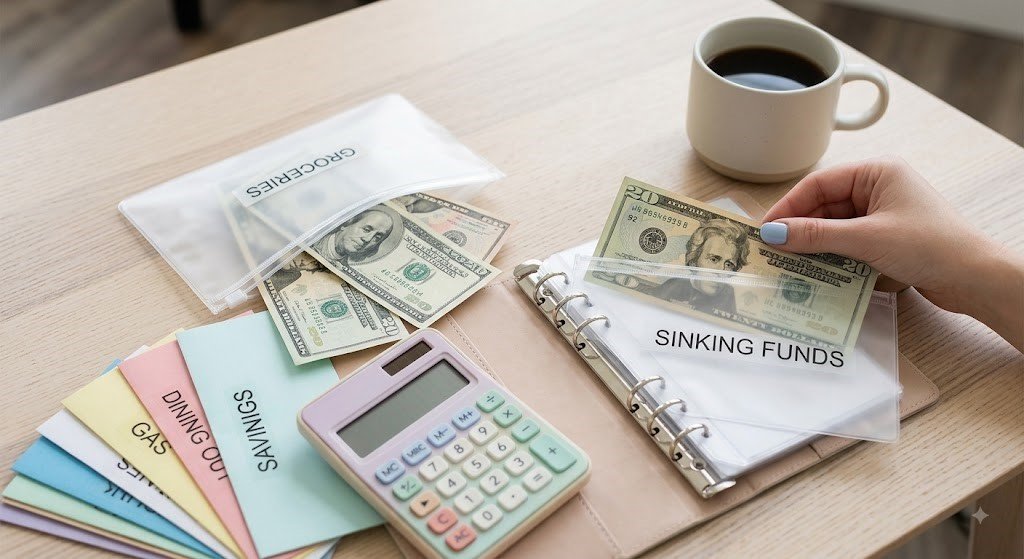
- Acquire Budgeting Tools: Purchase an A6 budget binder with clear zipper envelopes, or simply use standard paper envelopes labeled with permanent marker.
- Determine Envelope Thresholds: Review past bank statements to set realistic spending caps for each variable category. If you typically spend $600 a month on groceries, allocate $300 per bi-weekly paycheck to your Grocery envelope.
- Execute the ATM Withdrawal: On payday, pay your fixed digital bills first. Calculate the exact sum needed for your variable envelopes and withdraw that precise total in cash from your bank account.
- Stuff the Envelopes: Divide the physical bills into their respective binder pockets. Label each pocket clearly with its category name and starting balance.
Step 3: Managing Sinking Funds with Envelopes
A major advantage of cash stuffing is its ability to smooth out irregular or seasonal expenses through Sinking Funds.
Sinking funds are mini-savings accounts designed for specific future expenditures. Instead of being blindsided by annual car registration fees, holiday shopping, or routine maintenance, you build small cash reserves over time.
Popular Sinking Fund Envelopes:
- Emergency Micro-Fund: $20–$50 per paycheck for unexpected small repairs.
- Vehicle Maintenance: Fund ongoing oil changes, tire rotations, and brake replacements.
- Annual Subscriptions: Save monthly toward yearly software, domain, or membership renewals.
- Holidays & Birthdays: Spread gift-giving costs across all 12 months rather than relying on credit cards in December.
Step 4: How to Implement Digital Envelope Budgeting
If carrying physical cash feels inconvenient or unsafe for your routine, you can replicate the exact mechanics of cash stuffing using modern digital banking tools.
1. Use Sub-Accounts or “Savings Buckets”
Many modern digital banks and credit unions allow account holders to open multiple sub-accounts or “vaults” within a single master account. Name these sub-accounts after your budget categories (e.g., “Groceries,” “Dining Out,” “Car Maintenance”) and distribute your paycheck across them automatically.
2. Specialized Envelope Budgeting Apps
Software platforms like YNAB (You Need A Budget), EveryDollar, or Goodbudget utilize zero-based, virtual-envelope frameworks. They allow you to assign every digital dollar a job before spending it, delivering the same financial awareness as physical cash stuffing without requiring manual cash withdrawals.
Frequently Asked Questions (FAQ)
Is cash stuffing safe against theft or loss?
Carrying large sums of cash can present risk. To manage safety, keep high-value sinking fund envelopes stored in a fireproof home safe, and only carry the specific daily envelopes (like Gas or Groceries) you plan to use when leaving home.
What happens if an envelope runs out of money before payday?
When an envelope balance hits zero, spending in that category stops until the next pay cycle. If an essential purchase arises (e.g., prescription medication), you must deliberately transfer funds out of another discretionary envelope (like Entertainment) to cover the difference.
How do I handle online purchases while using cash stuffing?
For online transactions (e.g., ordering groceries online), leave the required amount in your checking account and take the equivalent physical cash out of the corresponding envelope, depositing it back into your bank account or placing it into a designated “Bank Deposit” envelope.
Final Thoughts
The cash stuffing method is far more than a trend; it is a battle-tested behavioral tool designed to restore intentionality to personal spending. By combining physical friction with clear categorical limits, you can halt impulse buying, end the paycheck-to-paycheck cycle, and build lasting financial momentum.