
- Introduction: The Fragility of the Paycheck-to-Paycheck Cycle
- Step 1: Rethinking the Target (The Starter Fund vs. Full Fund)
- Step 2: Uncovering “Invisible” Money in Your Budget
- Step 3: Automating the Savings Friction
- Step 4: Where to Keep Your Emergency Fund
- Frequently Asked Questions (FAQ)
- Final Thoughts
Introduction: The Fragility of the Paycheck-to-Paycheck Cycle
For millions of households, the end of the month brings a familiar sense of anxiety. Income arrives, pays fixed overhead, covers basic living costs, and leaves virtually nothing behind. Operating in this state means walking a financial tightrope without a net: a single flat tire, medical copay, or broken home appliance can force you to rely on high-interest credit cards or predatory payday loans.
This is how the debt cycle traps people. It isn’t always caused by reckless spending; often, it is simply the absence of a financial shock absorber.
An Emergency Fund is not luxury savings designated for vacations or home upgrades. It is liquid capital set aside strictly to cover unforeseen, unbudgeted life events.
If saving thousands of dollars feels impossible right now, this guide breaks down the process into small, manageable action steps designed specifically for tight budgets.
Step 1: Rethinking the Target (The Starter Fund vs. Full Fund)
One reason people give up on saving is that traditional advice can feel overwhelming. Financial experts often suggest saving 3 to 6 months of living expenses, which for most families translates to $10,000 to $25,000. When your checking account frequently approaches zero, that target feels entirely out of reach.
The solution is to separate your savings goal into two distinct phases:
| Stage | Target Amount | Primary Goal |
| Stage 1: Starter Emergency Fund | $1,000 | Stop relying on credit cards for minor daily surprises (e.g., car repairs, urgent dental work). |
| Stage 2: Full Emergency Reserve | 3–6 Months Expenses | Protect against major life events (e.g., job loss, medical leave, major home repairs). |
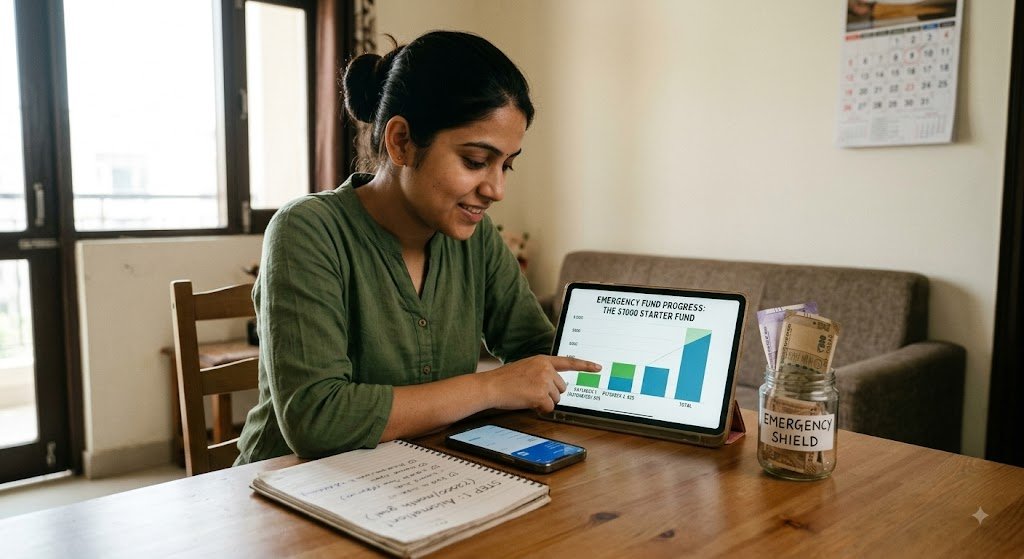
Your immediate objective is Stage 1. Reaching $1,000 breaks the immediate dependence on debt and gives you breathing room to tackle other goals.
Step 2: Uncovering “Invisible” Money in Your Budget
When money is tight, finding extra funds requires looking at small operational efficiencies rather than making drastic life changes.
1. Micro-Savings from Recurring Bills
Audit your fixed monthly bills. Contact service providers (internet, mobile, insurance) and ask for available discounts or retention rates. Lowering an internet bill by $20/month and auto insurance by $30/month frees up $50 every month to redirect straight into your emergency fund.
2. The “30-Day Rule” for Discretionary Purchases
Impulse purchases drain small sums that add up over time. Implement a strict rule: if you want to make a non-essential purchase over $30, wait 30 days. If the urge persists and fits your budget, buy it; if not, transfer that exact amount into your emergency fund.
3. Capture “Found Money”
Commit to saving 100% of non-standard income injections:
- Tax refunds
- Work bonuses or overtime pay
- Cashback rewards from credit/debit cards
- Proceeds from selling unused household items
Step 3: Automating the Savings Friction
Relying on willpower to save whatever is left over at the end of the month rarely works because unallocated cash naturally gets spent. You must pay yourself first.
  [ Incoming Paycheck ]
            │
            ├──────► [ Auto-Transfer: $25 to High-Yield Savings ] (Instant)
            │
            └──────► [ Remaining Checking Account ] ──► (Bill Pay & Living Costs)
How to Automate:
- Direct Deposit Split: Ask your employer’s payroll department to split your paycheck direct deposit. Have $25 or $50 routed automatically into a separate savings account, and the rest into your checking account.
- Scheduled Bank Transfers: Set up an automatic transfer on the exact day your paycheck hits your account.
Even saving $25 per week creates a $1,300 emergency buffer over 12 months without requiring major sacrifices.
Step 4: Where to Keep Your Emergency Fund
Your emergency fund must be kept separate from your everyday checking account so you aren’t tempted to spend it on daily purchases. However, it still needs to be easily accessible when a real emergency arises.
Recommended Account Structure:
- High-Yield Savings Account (HYSA): Choose an FDIC-insured online bank that offers higher interest rates than traditional brick-and-mortar banks. HYSAs keep your capital safe, liquid, and earning interest while keeping it out of sight from your daily debit card.
- No Debit Card Attached: Do not order a debit card for this account, or keep it stored safely at home rather than in your wallet. Adding a 1-to-2-day transfer delay between your HYSA and checking account prevents impulse spending.
Frequently Asked Questions (FAQ)
Should I build an emergency fund if I have high-interest credit card debt?
Yes. Save a $1,000 starter emergency fund first before aggressively paying down debt. If you throw every extra dollar at credit card balances without keeping a small cash buffer, the next unexpected $300 expense will go right back onto your credit card, resetting your progress.
What counts as a real emergency?
A real emergency passes three criteria: It is unexpected, necessary, and urgent.
- Valid Emergency: Car repair needed to drive to work, urgent medical bill, emergency home plumbing repair.
- Not an Emergency: Holiday gifts, annual sales, planned car maintenance, travel opportunities.
Final Thoughts
Building an emergency fund while living paycheck-to-paycheck is not about making massive financial moves overnight. It is built through small, consistent actions: saving $20 here, cutting an unused service there, and automating small transfers. Over time, that small cushion becomes a solid shield that protects your peace of mind and keeps you out of debt.