
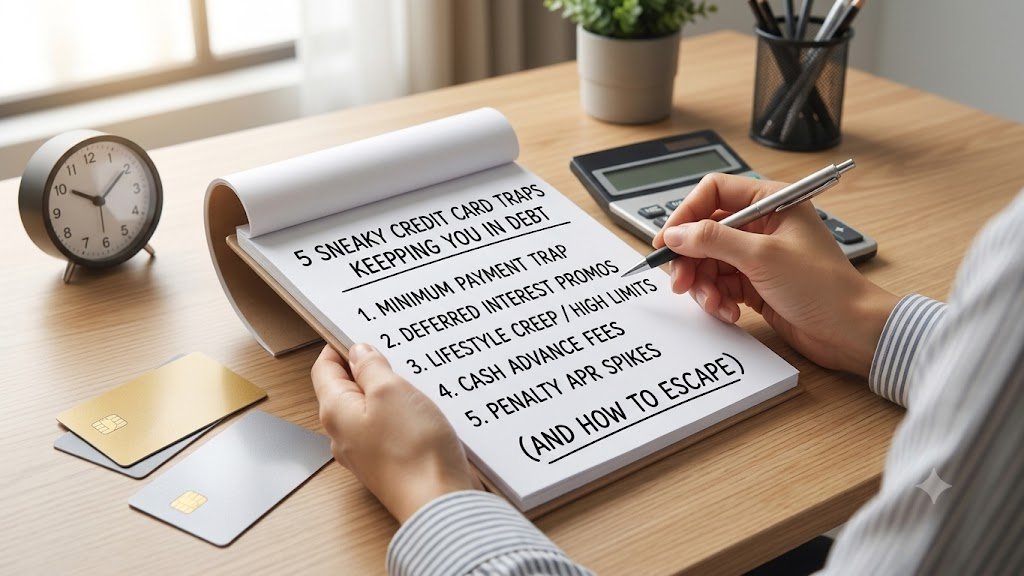
- Introduction
- 1. The “Minimum Payment” Trap
- Why It Kills Your Wallet
- How to Escape
- 2. Deferred Interest on 0% APR Promotions
- The Hidden Catch
- How to Escape
- 3. High Credit Limits That Trigger “Lifestyle Creep”
- The Psychology
- How to Escape
- 4. Cash Advance Interest Rates & Instant Fees
- The Real Cost
- How to Escape
- 5. Penalty APR Spikes
- How It Works
- How to Escape
- Final Words
Introduction
Credit cards are designed to be convenient financial tools, but for millions of people, they turn into long-term money traps. Credit card companies don’t make their billions when you pay off your card in full every month—they profit off fine print, sneaky fee structures, and psychological tricks that encourage you to stay in debt for as long as humanly possible.
If you feel like you’ve been making payments every month but your total credit card balance isn’t budging, you’ve likely fallen into one of these traps. Here are five sneaky ways credit card issuers keep you hooked—and how to break free today.
1. The “Minimum Payment” Trap
This is by far the biggest trap in modern banking. When you open your monthly statement, the largest, boldest number you see isn’t your full balance—it’s your Minimum Amount Due. Lenders make this number look small and manageable (usually around 1% to 2% of your balance) on purpose.
Why It Kills Your Wallet
If you have a $5,000 balance on a card with a 22% APR and you only pay the $100 minimum payment every month, it will take you over 18 years to pay off that card, and you will pay over $6,000 in interest alone!
How to Escape
Always pay more than the minimum, even if it’s just an extra $30 or $50 a month. Use an online debt payoff calculator to see how adding a small fixed amount dramatically slices years off your payback timeline.
2. Deferred Interest on 0% APR Promotions
We’ve all seen store store cards offering “0% Interest for 12 Months!” on electronics, furniture, or retail purchases. It sounds like free money, but there is a major catch hidden in the terms called Deferred Interest.
The Hidden Catch
With standard 0% intro APR credit cards, if you have a tiny balance left when the promo ends, you only pay interest on that remaining balance going forward.
With Deferred Interest (common on store financing cards), if you owe even $1 when month 12 hits, the bank retroactively charges you full interest on the entire original purchase amount all the way back to day one!
How to Escape
Divide your total purchase price by the number of promotional months minus one. For example, if you buy a $1,200 couch on a 12-month promo, pay $109 every month so the balance hits zero by month 11. Never leave it down to the last week!
3. High Credit Limits That Trigger “Lifestyle Creep”
When a credit card issuer suddenly sends you a notification saying, “Congratulations! We’ve increased your credit limit from $2,000 to $7,000,” it feels like a reward. But psychologically, it tricks your brain into thinking you have more spending power than you actually do.
The Psychology
As your credit limit expands, your spending habits naturally inflate to match it—a phenomenon known as lifestyle creep. Before you know it, balance levels that used to stress you out feel totally normal because your utilization percentage looks safe on paper.
How to Escape
Treat your credit card like a debit card. If you don’t have the hard cash sitting in your checking account to pay off the purchase today, don’t put it on the card—regardless of how high your credit limit is.
4. Cash Advance Interest Rates & Instant Fees
When you’re short on cash, slipping your credit card into an ATM to pull out bills seems like an easy fix. But cash advances are one of the most expensive financial transactions you can make.
The Real Cost
- Upfront Fees: Most cards charge an instant 3% to 5% fee on the total cash withdrawn.
- No Grace Period: Unlike regular purchases, cash advances start accruing interest immediately from the second the cash leaves the machine.
- Higher Interest Rates: Cash advance APRs are often 5% to 10% higher than your card’s standard purchase APR.
How to Escape
If you are in an emergency situation and need cash, explore personal emergency loans, balance transfers, or small peer-to-peer lending options rather than taking a credit card cash advance.
5. Penalty APR Spikes
Did you know that slipping up and missing a single payment by 60 days can cause your interest rate to double overnight?
How It Works
Hidden in your card member agreement is a clause for Penalty APR. If you go past-due, the credit card company can jack your interest rate up to 29.99% or higher on your existing balance and future purchases. Worse yet, they can keep that penalty APR active for up to 6 months even after you bring the account current!
How to Escape
Set up Auto-Pay for at least the minimum amount due on every credit card you own. Even if you plan to make a larger manual payment later in the month, auto-pay ensures you never miss a due date and protects you from trigger penalty APRs.
Final Words
Credit cards aren’t inherently bad, but they are built to extract maximum profits from people who don’t pay attention to the rules. By avoiding minimum payment traps, watching out for deferred interest fine print, and setting up automatic payments, you can take control of your cards instead of letting them control your wallet.
1 thought on “5 Sneaky Credit Card Traps Keeping You in Debt (And How to Escape)”