
- Number 1: Your Credit Utilization Ratio (The Credit Card Hangover)
- What Actually is It?
- Why This Number is Crucial (And How It Traps You)
- How to Fix Your Credit Utilization Ratio (Without Going Skint)
- Number 2: Your Debt-to-Income (DTI) Ratio (The Baseline Vulnerability Metric)
- What Actually is It?
- The Danger Zone
- How to Chop Down Your DTI Ratio
- When the Numbers Are Too High: Unsecured Debt Settlement
- Debt Consolidation vs. Debt Relief (Don’t Mix Them Up!)
- The Risks You Must Know
- The Bottom Line
Let’s be completely honest for a second. Most personal finance advice out there is a total head-scratcher. You read some dry, preachy article telling you to track every single penny, skip your daily flat white, or build a complex spreadsheet just to buy a loaf of bread. It’s exhausting, it’s boring, and quite frankly, it’s a massive shambles.
When you’re already stressed about money, staring at a mountain of bills, and living hand-to-mouth, the last thing you need is a lecture on “financial synergy.” You just want to know how to stop the bleeding, get the banks off your back, and reclaim your sanity.
Here’s the good news: you don’t need to track a million different metrics to win this game. In fact, when it comes to your creditworthiness and your overall financial power, there are really only two numbers that actually dictate the rules of your financial life.
If you get these two numbers sorted, the rest of your financial recovery will fall into place like clockwork. If you ignore them, you’re basically running on a treadmill that’s set to maximum speed and a vertical incline—spending a fortune every month but going absolutely nowhere.
Let’s unpack these two massive numbers, see how they’re silently controlling your life, and map out a practical, no-nonsense blueprint to take control of them today.
Number 1: Your Credit Utilization Ratio (The Credit Card Hangover)
First up is your Credit Utilization Ratio. This is the number that your credit score is absolutely obsessed with. If your credit score has taken a massive pasting recently, or if you’re struggling to understand why it won’t budge despite you making your payments on time, this sneaky little number is almost certainly the culprit.
What Actually is It?
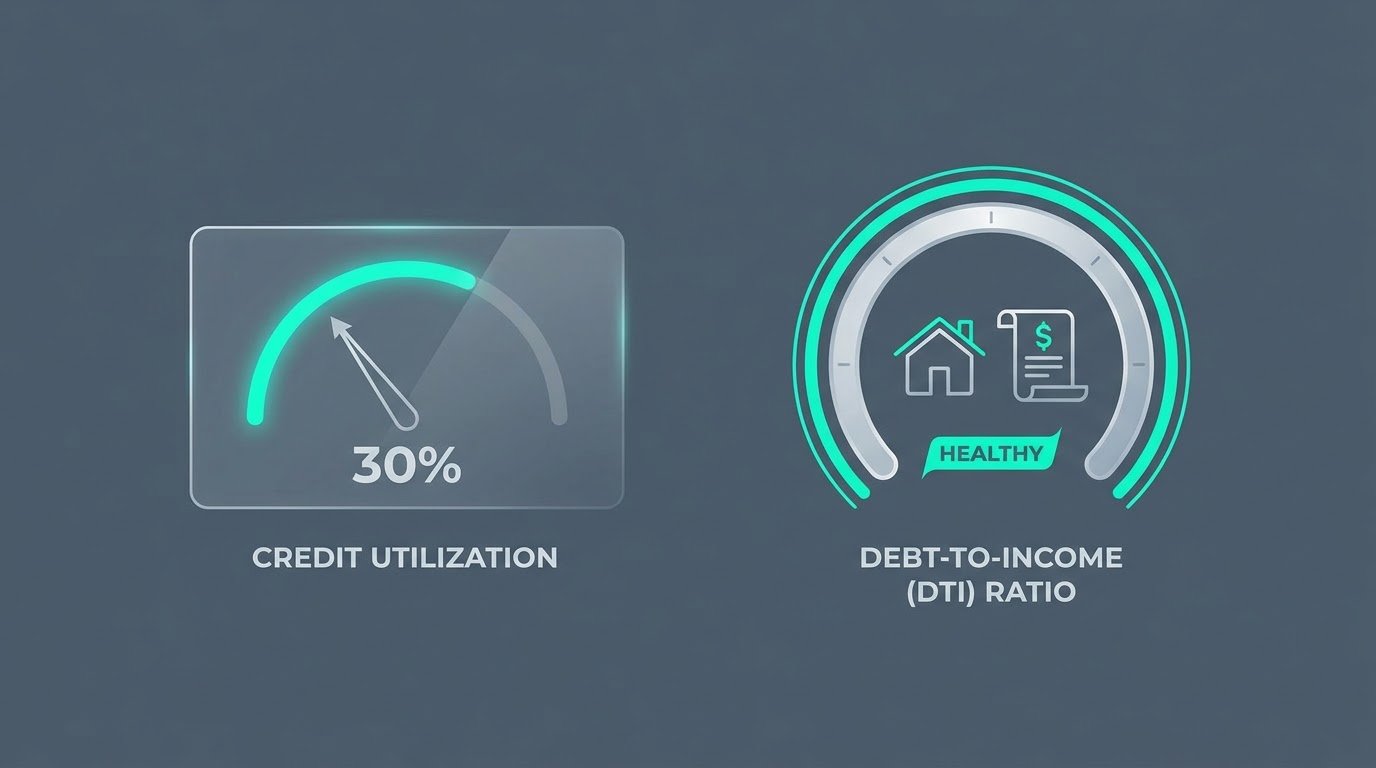
In simple terms, your credit utilization is a measure of how much of your available credit card limit you are actively using at any given moment. It’s expressed as a percentage.
For example, if you have a credit card with a limit of $10,000, and your current balance on that card is $3,000, your credit utilization ratio is 30%.
Here’s the catch: the credit bureaus (the folks acting like a nosy, judgmental neighbor tracking your every move) don’t just look at your total overall limit. They look at your utilization on each individual card as well as your overall combined limit.
Why This Number is Crucial (And How It Traps You)
Credit card companies make their absolute fortunes when you carry a high balance month after month. They profit off sneaky fine print, high interest rates, and psychological tricks designed to keep you trapped in a cycle of minimum payments.
When you max out your cards, or even carry a balance over 30% of your limit, the credit scoring systems panic. To them, you look like someone who is desperate for cash and on the brink of a financial meltdown—even if you’re planning to pay it all off next week.
Once your utilization crosses that 30% threshold, your credit score starts dropping fast. And if you’re carrying balances close to your limits (90% to 100% utilization), your score takes an absolute gut punch. This makes it almost impossible to get approved for a decent loan, rent an apartment, or get a low-interest balance transfer card to help you pay off what you owe.
How to Fix Your Credit Utilization Ratio (Without Going Skint)
If your cards are currently maxed out and you’re feeling completely overwhelmed, don’t panic. Here is how you actively claw this number back down:
- The Debt Avalanche vs. Debt Snowball: To drag your utilization down, you need a systematic payoff strategy. Under the Debt Avalanche, you focus all your extra cash on the account with the highest interest rate (APR) while paying minimums on the rest—this mathematically minimizes the total interest you pay. If you need quick emotional wins to stay motivated, use the Debt Snowball and attack your smallest balances first. Crossing an account off your list entirely is a massive psychological boost.
- Request a Limit Increase (But Don’t Spend It!): This is a cheeky but highly effective hack. If you have a decent payment history, call your card issuer and ask for a credit limit increase. If they bump your limit from $5,000 to $10,000, and your balance stays at $3,000, your utilization instantly drops from 60% to 30% without you paying a single extra penny. Warning: Only do this if you have the self-discipline to not spend that new credit!
- Micropayments: Don’t wait until the end of the month to make a payment. If you get paid weekly, or make a bit of extra cash from a side hustle, throw it at your card immediately. Making multiple smaller payments throughout the month keeps your average daily balance low, which is exactly what the credit bureaus report.
Number 2: Your Debt-to-Income (DTI) Ratio (The Baseline Vulnerability Metric)
While your credit utilization ratio is all about how you manage your plastic, your Debt-to-Income (DTI) Ratio is the ultimate measure of your actual real-world survival. It is the number that lenders look at to decide if you can actually afford your life, or if you’re drowning in structural friction.
What Actually is It?
Your DTI is the percentage of your gross monthly income (before taxes are taken out) that goes toward paying your mandatory monthly debt obligations.
To calculate your DTI, you add up all your fixed monthly debt payments—mortgages, auto loans, minimum credit card payments, student loans, and personal loans. Then, you divide that total by your gross monthly income.
$$ ext{DTI Ratio} = rac{ ext{Total Monthly Debt Payments}}{ ext{Gross Monthly Income}}$$
For example, if you bring home $5,000 a month before taxes, and your mandatory monthly debt payments total $2,000, your DTI is 40%.
The Danger Zone
In the personal finance world, a DTI of 36% or less is generally considered healthy. Once your DTI creeps over 43%, you are officially in the danger zone. Most traditional mortgage lenders and bank loan officers will look at you, shake their heads, and deny your application on the spot.
Why? Because when your fixed overhead is that high, you have absolutely zero margin for error. If every single dollar entering your bank account is committed to a creditor before it even arrives, a single minor emergency—like a flat tire, a broken boiler, or a sudden dental bill—will completely ruin your budget and force you right back onto high-interest credit cards.
How to Chop Down Your DTI Ratio
If your DTI is currently sitting at a level that makes your stomach churn, breaking the cycle requires a deliberate strategy that combines behavioral spending pauses, structural cost-cutting, and aggressive principal reduction.
Here is your 3-step action plan to bring this number down:
- Eliminate Behavioral Leaks with the 48-Hour Rule: Unplanned impulse spending drains your cash reserves quietly. To stop this, introduce intentional friction: whenever you want to make a non-essential purchase over $50, force a mandatory 48-hour cooling-off period. Place it in an online cart or walk out of the store. This pause breaks the psychological impulse loop, letting stress or emotional fatigue settle before you part with your hard-earned cash.
- Audit Your Fixed Overhead and Subscriptions: Download your last 90 days of bank statements and highlight every single recurring charge. Cancel the unused gym memberships, forgotten streaming apps, and premium software trials immediately. For your high-cost utility bills (broadband, mobile carrier, insurance), call them up and politely negotiate retention discounts or ask for updated rate structures.
- Build a $1,000 Liquid Buffer: Before you throw every extra penny at your debt, you must establish an immediate $1,000 cash safety buffer. Keep this separate in a dedicated savings account. Without this liquid safety net, any minor emergency will force you to rely on credit cards, dragging your utilization and DTI straight back up.
When the Numbers Are Too High: Unsecured Debt Settlement
But what if your numbers are so far gone that minimum payments are barely covering the accruing interest? What if your principal balance is staying virtually untouched, and you’re staring down a 20-year cycle of endless financial stress?
If you are facing genuine financial hardship (like a job loss, medical crisis, or divorce) and simply cannot pay off your debts within 3 to 5 years, it might be time to look at a Debt Relief Program (often called debt settlement).
Debt Consolidation vs. Debt Relief (Don’t Mix Them Up!)
It is incredibly important to understand the difference between these two strategies:
- Debt Consolidation: You take out one large personal loan (hopefully with a much lower interest rate) to pay off all your smaller credit card balances. You still pay back 100% of the money you borrowed, but you simplify your bills into one monthly payment.
- Debt Relief/Settlement: This is for unsecured debts only (credit cards, personal loans, store cards—not mortgages or auto loans). You stop paying your creditors directly and instead put a set monthly amount into a dedicated, FDIC-insured escrow account in your name. Once you have built up a lump sum, professional negotiators use your financial hardship as leverage to convince banks to settle the debt for 50% to 70% of the total balance, forgiving the remaining amount.
The Risks You Must Know
While slashing your principal in half sounds amazing, debt settlement isn’t a magical free pass. You have to be realistic about the trade-offs:
- Temporary Credit Hit: Because you stop paying your creditors while saving up your settlement fund, your credit score and utilization will drop initially from the late payments. However, if you are already struggling or maxed out, your score is already taking a beating. Settling allows you to wipe the slate clean and rebuild on solid ground.
- IRS Tax Trap (The 1099-C): If a creditor forgives $600 or more, the IRS treats that forgiven debt as taxable income. You might receive a 1099-C form at tax time. Fortunately, if you can show the IRS you were “insolvent” (your total debts exceeded your total assets at the time of settlement), you may not owe taxes on it by filing IRS Form 982. Always check with a qualified tax advisor!
The Bottom Line
Your journey to complete financial independence doesn’t require a degree in economics or a life of miserable deprivation. It starts with taking deliberate, focused action on these two numbers.
Establish your starter buffer, audit your bank statements, apply the 48-Hour rule, and pick your systematic debt payoff strategy. Take it one step at a time, commit to the process, and stay consistent. You’ve got this!
What’s your current focus—bringing down your credit utilization or tackling your DTI ratio? Let us know in the comments below!