
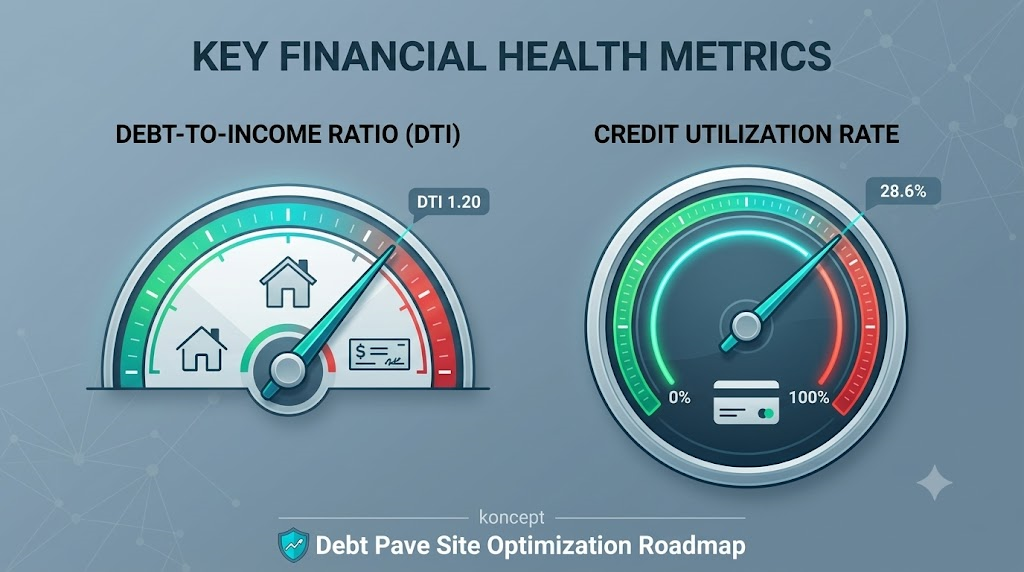
- Number 1: Your Debt-to-Income (DTI) Ratio (The Lender’s Gatekeeper)
- How to Calculate Your DTI
- The DTI Thresholds That Matter
- Why DTI Matters to You
- Number 2: Your Credit Utilization Ratio (The Credit Score King)
- How to Calculate Credit Utilization
- The Golden Rule of Credit Utilization
- DTI vs. Credit Utilization: The Side-by-Side Comparison
- How to Optimize Both Numbers to Pave Your Path to Wealth
The Two Numbers That Actually Rule Your Financial Life (DTI vs. Credit Utilization)
If you’ve ever felt like your personal finances are a black box, you are not alone. Between credit scores, interest rates, and savings yields, it feels like you need a math degree just to keep your head above water. But here is the secret: you do not need to track a hundred different metrics.
In fact, there are just two critical numbers that dictate your financial freedom, your creditworthiness, and your ability to build wealth.
These two numbers are your Debt-to-Income (DTI) Ratio and your Credit Utilization Ratio.
Once you understand how these two metrics work—and more importantly, how to manipulate them in your favor—you can stop playing defense and start paving a clean path to wealth. Let’s break them down side-by-side.
Number 1: Your Debt-to-Income (DTI) Ratio (The Lender’s Gatekeeper)
Your Debt-to-Income (DTI) ratio is the primary number that lenders look at when you want to buy a house, purchase a car, or secure a personal loan. It measures the percentage of your gross monthly income that goes toward paying your recurring monthly debt obligations.
How to Calculate Your DTI
To find your DTI, use this simple formula:
$$\text{DTI} = \left( \frac{\text{Total Monthly Minimum Debt Payments}}{\text{Gross Monthly Income}} \right) \times 100$$
For example, if your gross monthly income (before taxes) is $5,000, and your monthly minimum payments (rent/mortgage, auto loan, student loan, and credit card minimums) total $1,800:
$$\text{DTI} = \left( \frac{1,800}{5,000} \right) \times 100 = 36%$$
The DTI Thresholds That Matter
- 35% or Less (Excellent): You have a healthy balance of income and debt. Lenders view you as a low-risk borrower.
- 36% to 43% (Moderate): You have manageable debt, but large loans (like a new mortgage) might require stricter underwriting.
- 43% or Higher (Critical): This is the threshold where traditional lenders often draw the line. High DTI indicates that you are living on the edge of your means and have very little cash flow buffer.
Why DTI Matters to You
Even if you are not applying for a loan, a high DTI is a warning sign of cash flow friction. When a huge chunk of your paycheck is spoken for before it even hits your account, saving for emergencies or investing for retirement becomes nearly impossible.
Number 2: Your Credit Utilization Ratio (The Credit Score King)
While DTI measures your income against your debt, your Credit Utilization Ratio measures your revolving debt balances against your credit limits. This single number accounts for 30% of your total FICO® score calculation, making it the second most important factor behind your payment history.
How to Calculate Credit Utilization
Unlike DTI, credit utilization completely ignores your income. It is calculated by dividing your total outstanding credit card balances by your total available revolving credit limits:
$$\text{Credit Utilization} = \left( \frac{\text{Total Credit Card Balances}}{\text{Total Credit Card Limits}} \right) \times 100$$
For example, if you have two credit cards with a combined limit of $10,000, and your current outstanding balances total $4,000:
$$\text{Credit Utilization} = \left( \frac{4,000}{10,000} \right) \times 100 = 40%$$
The Golden Rule of Credit Utilization
Personal finance experts agree that you should keep your credit utilization under 30% on both an individual card level and an aggregate level. However, for an elite credit score, keeping it under 10% is the sweet spot. High utilization signals to credit bureaus that you are overextended, dragging down your score even if you pay your bills on time.
DTI vs. Credit Utilization: The Side-by-Side Comparison
| Feature | Debt-to-Income (DTI) Ratio | Credit Utilization Ratio |
|---|---|---|
| What it measures | Monthly debt payments vs. Gross monthly income | Credit card balances vs. Revolving credit limits |
| Who cares about it | Mortgage, auto, and personal loan underwriters | Credit bureaus (FICO/VantageScore) and card issuers |
| Impact on credit score | None (income is not on your credit report) | Massive (30% of your total score calculation) |
| Target benchmark | Under 36% (ideally lower) | Under 30% (under 10% for excellent credit) |
| How to improve it | Increase income OR pay off recurring debt balances | Pay down card balances OR request a credit limit increase |
How to Optimize Both Numbers to Pave Your Path to Wealth
Improving these two numbers requires a deliberate, double-edged strategy. Here is how you can systematically lower both:
- Request a Credit Limit Increase (Lowers Utilization Instantly): Call your credit card issuers and request a higher limit. As long as you do not increase your spending, your available credit goes up, which immediately pushes your utilization ratio down.
- Consolidate Credit Card Debt into an Installment Loan (The Double-Win): Credit utilization only measures revolving debt (credit cards). Installment debt (like personal loans) is excluded from the calculation. By taking out a low-interest personal loan to pay off your credit cards, you drop your credit utilization to 0% almost overnight, boosting your credit score. Plus, a lower, fixed monthly payment can reduce your DTI!
- Implement a Behavioral Spending Pause (The 48-Hour Rule): To prevent running up card balances in the first place, force a mandatory 48-hour cooling-off period on all non-essential purchases over $50. This simple behavioral friction keeps variable credit card spending under lock.
- Audit Fixed Overhead: Review your recurring subscriptions and fixed fees from your monthly bank statements. Every dollar you cut from your monthly overhead is a dollar you can redirect toward paying down principal debt.