
- What is the Debt Snowball Method?
- How the Debt Snowball Works
- Why It Works (The Psychology)
- What is the Debt Avalanche Method?
- How the Debt Avalanche Works
- Why It Works (The Mathematics)
- Side-by-Side Comparison: Snowball vs. Avalanche
- A Real-World Scenario: Snowball vs. Avalanche
- 1. Under the Debt Snowball:
- 2. Under the Debt Avalanche:
- Which Strategy Will Set You Free First?
Staring down thousands of dollars in credit card balances, personal loans, or medical bills is one of the most stressful financial situations anyone can experience. Watching interest charges pile up month after month can make you feel like you are running on an endless financial treadmill.
To break this cycle, you need more than just good intentions—you need a structured, repeatable framework.
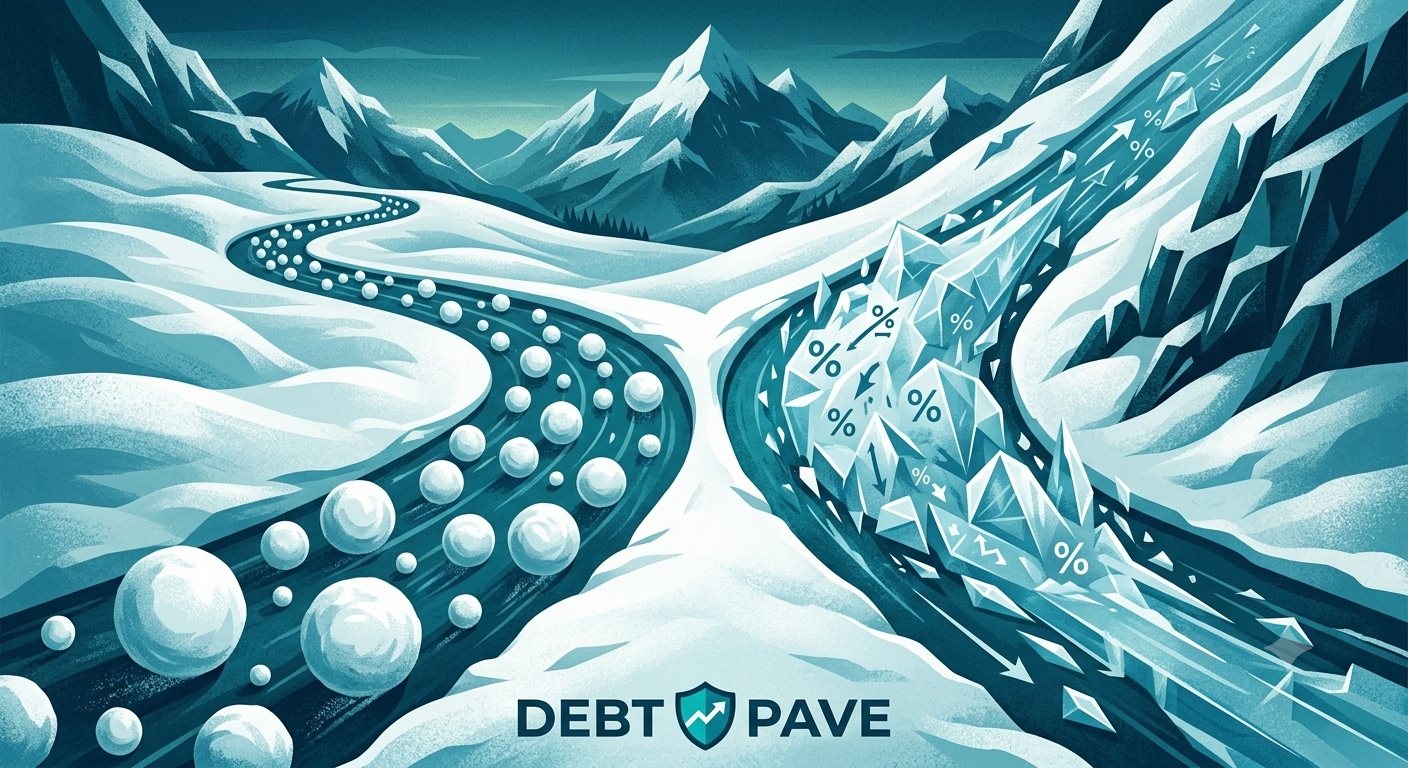
Personal finance experts widely agree on two highly effective frameworks for systematic debt elimination: The Debt Snowball and The Debt Avalanche. While both methods require making minimum payments on all your obligations while directing extra cash toward a single target debt, they approach the task from completely different angles.
What is the Debt Snowball Method?
The Debt Snowball strategy prioritizes behavioral psychology to build momentum. With this method, you pay off your debts in order of smallest balance to largest balance, regardless of the interest rate.
How the Debt Snowball Works
- List all your debts from the smallest outstanding balance to the largest.
- Make minimum payments on every debt except the smallest one.
- Throw all extra cash (budget savings, side hustle income, tax refunds) at the smallest debt until it is completely wiped out.
- Take the entire payment amount you were directing to that first debt (minimum payment + extra cash) and roll it into the next smallest debt.
- Repeat this process, creating a “snowball” effect as each eliminated debt frees up more cash to tackle the next.
Why It Works (The Psychology)
The main benefit of the Debt Snowball is psychological. By wiping out a small debt in the first 30 to 60 days, you get an immediate “quick win.” This releases dopamine, increases your confidence, and proves to you that the system works, keeping you motivated to tackle larger debts.
What is the Debt Avalanche Method?
The Debt Avalanche strategy prioritizes mathematical efficiency to minimize your total cost of borrowing. With this method, you pay off your debts in order of highest interest rate (APR) to lowest interest rate, regardless of the balance size.
How the Debt Avalanche Works
- List all your debts from the highest interest rate to the lowest.
- Make minimum payments on every debt except the one with the highest interest rate.
- Direct all extra funds toward the highest interest rate debt.
- Once that debt is paid off, roll its entire payment (minimum + extra) into the debt with the next highest interest rate.
- Repeat this process until you are completely debt-free.
Why It Works (The Mathematics)
By targeting the most expensive debt first, you prevent high-interest charges from compounding. This mathematically guarantees that you will pay the absolute least amount of total interest and, in most cases, become debt-free faster.
Side-by-Side Comparison: Snowball vs. Avalanche
| Feature | Debt Snowball | Debt Avalanche |
|---|---|---|
| Primary Focus | Behavioral Psychology & Momentum | Mathematical Efficiency & Interest Savings |
| Ordering Metric | Smallest Balance to Largest Balance | Highest Interest Rate (APR) to Lowest |
| Key Advantage | Quick wins keep you motivated and reduce stress | Saves the most money by eliminating high interest |
| Key Disadvantage | More expensive in total interest paid over time | Takes longer to get the first “win” if the highest-interest debt is large |
| Best For | People who need visual progress to stay on track | People who are analytical and motivated by saving money |
A Real-World Scenario: Snowball vs. Avalanche
Let’s look at a realistic scenario with three debts and $500 of extra monthly payoff cash:
- Debt A: $1,500 credit card balance at 24% APR (Minimum payment: $45)
- Debt B: $5,000 personal loan at 8% APR (Minimum payment: $120)
- Debt C: $10,000 student loan at 4.5% APR (Minimum payment: $110)
1. Under the Debt Snowball:
You target Debt A ($1,500) first because it is the smallest balance. It also happens to be high-interest, but that is secondary. You pay off Debt A in less than 3 months, creating an immediate psychological win. Next, you focus on Debt B, and finally Debt C.
2. Under the Debt Avalanche:
You target Debt A (24% APR) first because it has the highest interest rate. After Debt A is wiped out, you move to Debt B (8% APR), and lastly Debt C (4.5% APR).
In this specific case, because the smallest debt also carried the highest interest rate, both methods align. However, if Debt C had the 24% interest rate, the Avalanche would target the $10,000 balance first (taking many months to see a win), while the Snowball would still start with the $1,500 balance to build momentum.
Which Strategy Will Set You Free First?
The ultimate answer depends on your personality:
- If you find yourself starting financial plans and abandoning them because you don’t see immediate progress, choose the Debt Snowball. The emotional lift of crossing debts off your list is what will keep you in the game.
- If you are disciplined, highly analytical, and lose sleep over interest rates compounding, choose the Debt Avalanche. You will save money and enjoy the satisfaction of knowing you beat the banks at their own game.
The best strategy is not the one that is technically perfect on paper—it is the one you can actually stick to until your balances hit zero.