
- Why 90 Days? (The Danger of the Monthly Snapshot)
- Step 1: Ingesting the Data (Downloading the Raw Statements)
- Step 2: The Color-Coded Flagging System
- 1. The Green Light (Bare Essentials)
- 2. The Yellow Light (High-Cost Fixed Bills)
- 3. The Pink Light (Low-Value & Unused Subscriptions)
- Step 3: Cancel Unused Services Immediately (Pruning the Waste)
- Step 4: Negotiate High-Cost Fixed Bills (The Script Blueprint)
- The Internet / Mobile Phone Negotiation Script
- Side-by-Side Localization: US vs. UK Financial Audit
- Redirecting the Cash Flow: The Ultimate Payoff
- Summary Checklist: Your Day 2 Action Plan
Let’s be brutally honest for a minute: most of us have no idea where our money actually goes. We like to think we do. We comfort ourselves with vague mental math, telling ourselves that we “only spend a bit” on eating out or that our monthly bills are “pretty much standard.”
But the reality? Your bank account is likely bleeding cash from a dozen different microscopic cuts, and you’re letting it happen on autopilot.
While variable impulse spending—like that late-night online shopping spree or the daily premium coffee run—is easy to spot (and beat with systems like the 48-Hour Holding Period), it’s actually your fixed monthly overhead that determines your baseline financial vulnerability. When your fixed recurring bills are bloated, your financial margin shrinks to zero. Every single dollar that enters your account is already claimed before it even arrives, leaving you completely exposed to the next emergency.
If you are sick of running on the paycheck-to-paycheck treadmill, it’s time to stop guessing and start auditing.
Welcome to Day 2 of our 30-Day Financial Breakout Series. Today, we are executing a complete, step-by-step 90-Day Bank Statement Audit. This isn’t a boring lecture on frugality; it’s a tactical search-and-destroy mission designed to identify forgotten recurring subscriptions, eliminate cash leaks, and renegotiate high-cost fixed bills to immediately claw back hundreds of dollars in monthly cash flow.
Let’s dive in.
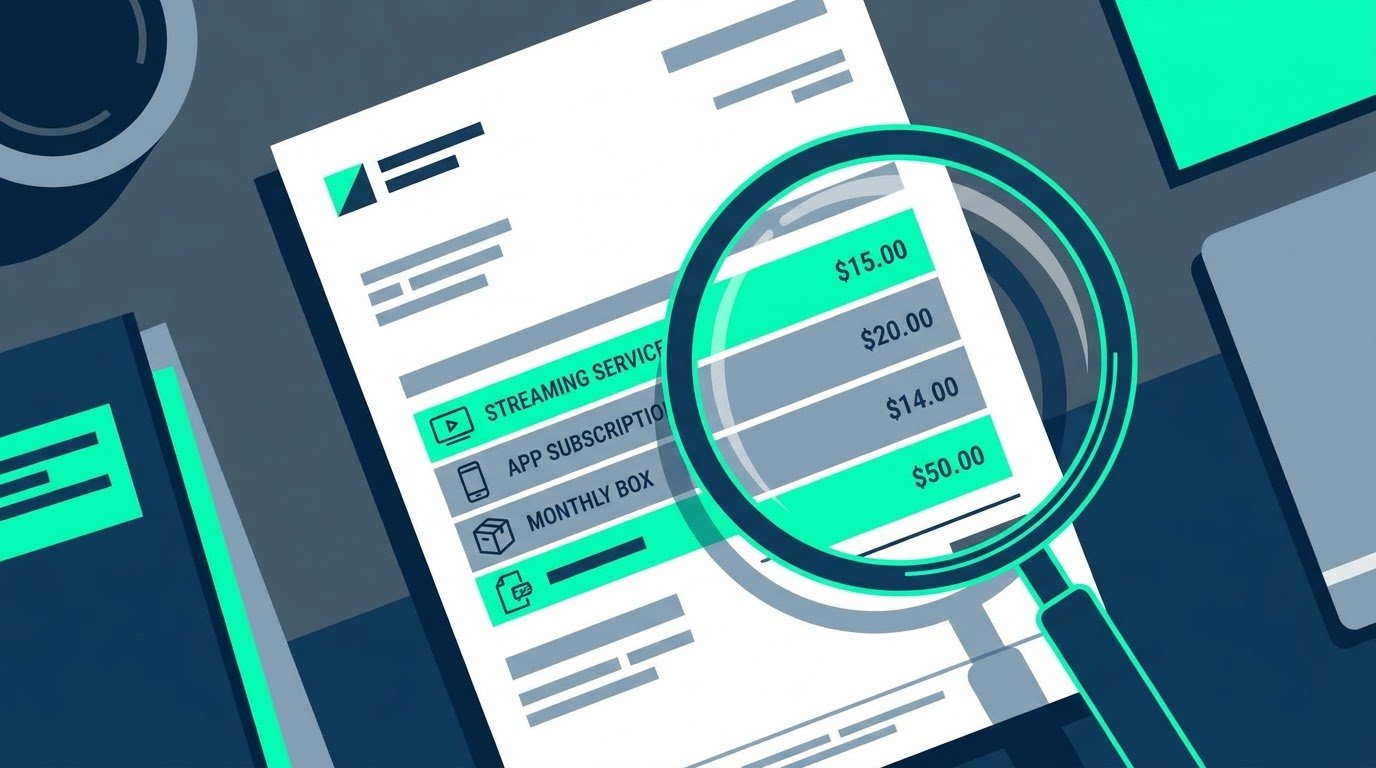
Why 90 Days? (The Danger of the Monthly Snapshot)
Why do we look at three months of transaction history instead of just last month’s statement?
Simple: financial life doesn’t run on a neat 30-day cycle.
If you only audit the last 30 days, you will completely miss quarterly subscriptions, bi-monthly utility adjustments, seasonal cash leaks, and annual renewals. A 90-day audit gives you a statistically representative window. It forces every sneaky charge, every forgotten software license, and every “free trial” that quietly transitioned into a paid subscription to stand up and face the music.
By analyzing the past 90 days, you establish an undeniable, mathematically accurate baseline of your true survival cost and identifying exactly how much waste is dragging down your financial recovery.
Step 1: Ingesting the Data (Downloading the Raw Statements)
The very first action is the easiest, yet it’s where most people stall out due to pure friction. Do not let resistance win before you even start.
- Log into your banking portal (or portals, if you use multiple accounts).
- Navigate to the statements section and download the PDF or CSV versions of your statements covering the last 90 days.
- Include your primary credit card statements as well. If you pay your recurring bills through a specific card to rack up points, that card’s statement is where the leaks are hidden.
- Print them out or open them in a clean, dual-screen layout. If you prefer digital, use a PDF annotation tool with different colored highlighters. If you prefer paper, grab three actual highlighters: one green, one yellow, and one pink.
Step 2: The Color-Coded Flagging System
Now, we conduct a line-by-line autopsy of your spending. Review every single transaction over the last 90 days. No skipping, no ignoring “small” charges. Every transaction must be color-coded into one of three categories:
                  +-----------------------------------+
                  | Download 90-Day Bank Statements   |
                  +-----------------------------------+
                                    |
                  +-----------------------------------+
                  | Flag Recurring Subscriptions      |
                  +-----------------------------------+
                                    |
        +---------------------------+---------------------------+
        |                                                       |
        v                                                       v
+-------------------------------+               +-------------------------------+
| CANCEL Unused/Low-Value       |               | NEGOTIATE High-Cost Fixed     |
| Subscriptions Immediately     |               | Bills (Insurance, Telecom)    |
+-------------------------------+               +-------------------------------+
1. The Green Light (Bare Essentials)
These are your non-negotiable survival expenses. They keep a roof over your head, the lights on, and food on the table.
- Examples: Rent or mortgage payments, basic groceries, core utility bills (electricity, water), and minimum debt repayments.
- Action: Leave these alone for now. They represent your absolute survival budget baseline.
2. The Yellow Light (High-Cost Fixed Bills)
These are services you absolutely need, but you are almost certainly paying too much for them because of the “loyalty penalty.”
- Examples: Internet, mobile phone plans, car insurance, home insurance, and essential telecom bundles.
- Action: Flag these for negotiation. (We will provide the exact scripts below).
3. The Pink Light (Low-Value & Unused Subscriptions)
These are discretionary, recurring luxury leakages. These services charge you automatically every month, whether you use them or not.
- Examples: Forgotten streaming platforms, unused gym memberships, premium software trials, delivery bundles, news paywalls, and app subscriptions.
- Action: Cancel immediately without mercy.
Step 3: Cancel Unused Services Immediately (Pruning the Waste)
Once you’ve colored your statements, the pink items must be dealt with. Do not tell yourself, “Oh, I might use that streaming app next month.” If you haven’t logged into it in the last 30 days, it is dead weight.
Cancel them immediately. If an app or service makes it incredibly difficult to unsubscribe, do not let that friction stop you. Use their customer service chat, send the cancellation email, or use an automated subscription-pruning tool to execute the cancellation on your behalf.
Think about the math: three unused streaming subscriptions at $15/month is $45 a month. Add in an unused gym membership ($40/month) and an old software trial you forgot to cancel ($10/month), and you are hemorrhaging $95 every single month. Over a year, that is $1,140 of your hard-earned cash vanishing into thin air for services you do not even use!
Step 4: Negotiate High-Cost Fixed Bills (The Script Blueprint)
For the yellow-light items—the essential recurring bills you can’t cancel—your goal is to lower the rate. Internet service providers, mobile carriers, and insurance companies rely heavily on “customer inertia.” They know most people will simply pay the higher rate rather than spend 15 minutes on the phone.
You are going to break that inertia.
Call your providers once a year to request retention discounts or updated rate structures. To make this as easy as possible, here are word-for-word, highly persuasive negotiation scripts.
The Internet / Mobile Phone Negotiation Script
When you call, bypass the front-line customer service representatives. You want to speak directly with the Retention Department (sometimes called the “Cancellation” or “Disconnections” department). These agents have the actual authority to credit your account or apply steep promotional discounts to keep you from leaving.
You: “Hi, I was looking over my bank statements and realized my monthly bill has crept up significantly. I’ve been a loyal customer for [X] years, but with the current cost of living, this bill is no longer sustainable for my budget. Before I look into switching my service to a competitor, I wanted to call and see if you could apply any current promotional rates or loyalty discounts to my account to bring this monthly cost down.”
Agent: “I understand, let me check. Unfortunately, you are already on our standard pricing, and we don’t have any promotions active for your plan right now.”
You (The Pivot): “I appreciate you checking. However, I see that new customers are currently being offered a rate of [insert competitor rate or their own new-customer promo rate] for similar speeds/data limits. As a long-term customer who has always paid on time, it’s hard to justify paying [X]% more than a brand-new customer. If we can’t find a way to match that pricing or apply a retention credit, I’ll need to be transferred to the cancellation department so I can schedule my service to end at the billing cycle.”
Agent: “Okay, please hold. Let me speak to my manager to see if we can apply a loyalty discount…”
Nine times out of ten, they will suddenly “discover” a retention discount that knocks $20 to $40 off your monthly bill. If they say no, don’t panic. You don’t actually have to cancel that day—you can politely say you need to discuss it with your household first. But more often than not, calling their bluff results in an immediate reduction.
Side-by-Side Localization: US vs. UK Financial Audit
Personal finance terms vary depending on which side of the pond you are on. When auditing your accounts, make sure you are looking out for these specific localized instruments:
| Feature/Term | 🇺🇸 United States Focus | 🇬🇧 United Kingdom Focus |
|---|---|---|
| Primary Account | Checking Account | Current Account |
| Automatic Bill Payments | Auto-pay, ACH transfers | Direct Debits, Standing Orders |
| Fixed Cost Leak Targets | Cable packages, streaming bundles, gym contracts, cellular family plans | High street gym memberships, premium TV subscriptions (Sky/Virgin), broadband tariffs, energy supplier rates |
| Typical Hidden Fees | Out-of-network ATM fees, monthly maintenance fees, overdraft penalties | Bank account package fees, credit card card fees, unarranged overdraft interest |
| Annual Negotiation Focus | Auto insurance premium, home insurance, mobile carrier packages | Car insurance, home insurance, energy tariff limits, broadband packages |
In the UK, pay special attention to your Direct Debits and Standing Orders. These are automated portals that companies use to draw cash straight from your current account. In the US, look closely at your ACH transfers and credit card auto-payments.
Redirecting the Cash Flow: The Ultimate Payoff
What do we do with the money we just clawed back?
If your 90-day audit successfully cancels $80 in unused subscriptions and negotiates another $60 off your internet and insurance bills, you have just freed up $140 of monthly cash flow.
Do not let this money slip back into your variable checking account to be spent on weekend takeaways or impulse purchases. You must immediately redirect this newly recovered capital with intention:
- Build Your Starter Buffer first: If you don’t have a cash safety net, automate a monthly transfer of this $140 directly into your dedicated High-Yield Savings Account until you establish an immediate $1,000 / £1,000 liquid emergency safety buffer. This buffer acts as a shield to prevent you from falling back into high-interest credit card debt when life throws a curveball.
- Fuel Your Debt Payoff System: Once your emergency buffer is fully funded, throw this extra $140 directly toward your target debt inside your chosen framework. Whether you use the behavioral Debt Snowball (targeting the smallest dollar balance for quick dopamine wins) or the mathematical Debt Avalanche (targeting the highest APR account to minimize interest), this extra $140 acts as an accelerant to wipe out your balances months ahead of schedule.
Summary Checklist: Your Day 2 Action Plan
To help you stay on track, print out or save this Day 2 checklist to execute your audit today:
- [ ] Download: Get PDF/CSV statements for all checking, current, and credit card accounts for the past 90 days.
- [ ] Highlight: Code your transactions (Green for survival essentials, Yellow for high-cost fixed bills, Pink for discretionary subscriptions).
- [ ] Prune: Unsubscribe from every single pink-highlighted service you haven’t used in the last 30 days.
- [ ] Negotiate: Call your internet, mobile, and insurance providers using our word-for-word scripts to request loyalty pricing.
- [ ] Redirect: Set up an automatic transfer on payday to route your newly recovered cash flow straight into your emergency buffer or debt payoff target.
Disclaimer: DebtPave provides free, educational personal finance resources to help you take control of your cash flow. We are not certified financial advisors or legal experts. Always consult with a registered professional before making major financial decisions.