
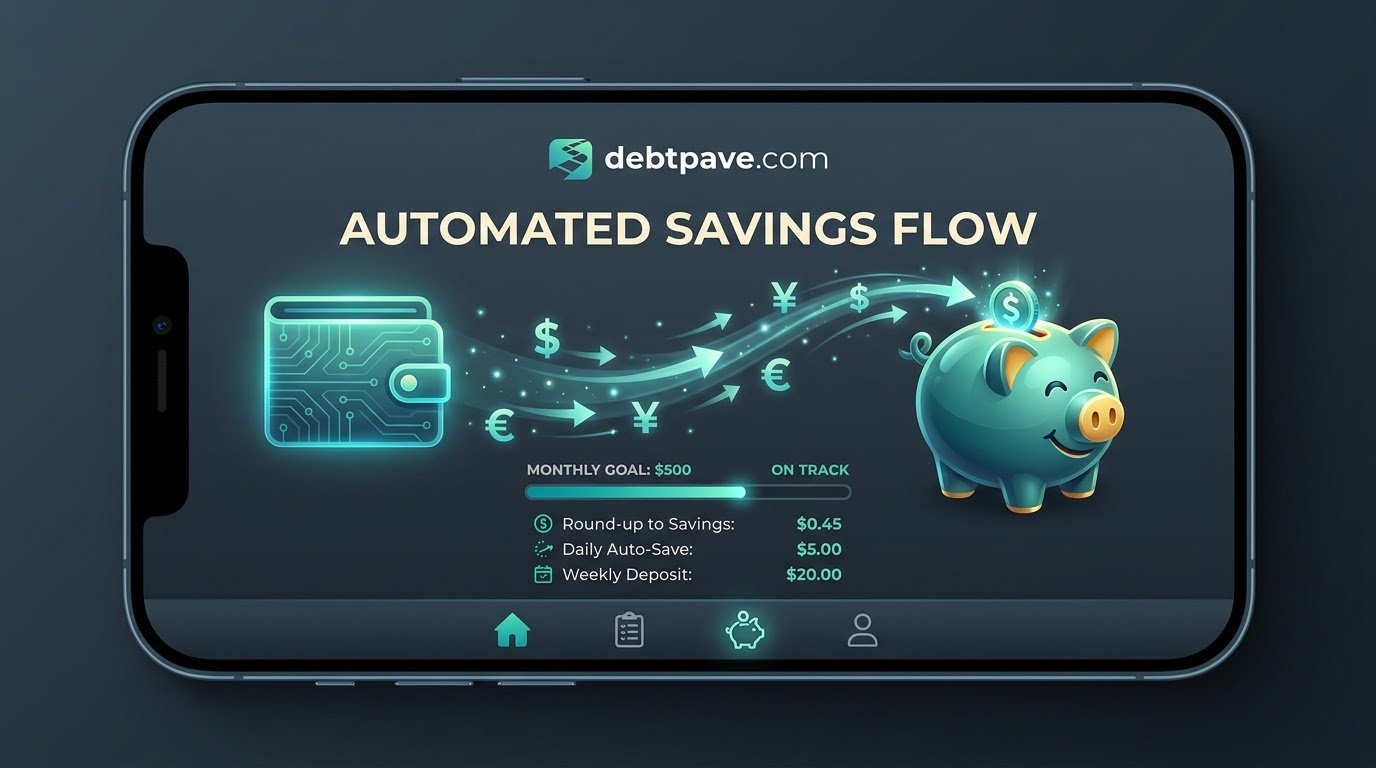
- The Psychology of the Micro-Deposit: Why “Invisible” Cash Wins
- 3 High-Impact Automatic Savings Tricks to Set Up Today
- Trick 1: The “Pay-Yourself-First” Paycheck Split
- Trick 2: Programmatic Micro-Transfers (The “Weekly Sneak”)
- Trick 3: Digital Debit Card Round-Ups (“Spare-Change Round-Ups”)
- 🇬🇧 vs. 🇺🇸 Automation Terminology Guide
- Overcoming the “Empty Account” Panic: Setting Up Your Automation Guardrails
- Your Action Plan for Today: The 10-Minute Automation Sprint
Let’s face a hard psychological truth about human behavior: if saving money requires you to make a conscious, disciplined decision every single week, you are eventually going to fail.
We live in a world designed to make spending as effortless as possible. Marketers and retail giants spend billions refining “one-click checkouts,” frictionless mobile payments, and personalized ads that hit our screens when we are tired, stressed, or bored. If your savings strategy relies entirely on “willpower”—meaning you wait until the end of the month, see what cash is left in your checking account, and try to manually transfer it to savings—you’ll find yourself staring at an empty account month after month.
Human willpower is a finite resource. When you’ve had a grueling 10-hour day at work, your brain is not interested in mathematical optimization or long-term financial security; it wants an immediate dopamine hit.
The secret to breaking the paycheck-to-paycheck trap is to remove human willpower from the equation entirely. You must fight frictionless spending with frictionless saving.
Today, for Day 4 of our financial breakout series, we are exploring the high-impact world of automated savings tricks. We will set up programmatic, behind-the-scenes banking rules that quietly sneak small, unnoticeable increments of cash away from your paycheck before you ever have a chance to spend it.
The Psychology of the Micro-Deposit: Why “Invisible” Cash Wins
If you try to manually cut $200 out of your checking account on payday, your brain registers it as a loss. You feel the immediate sting of deprivation. You look at your lower bank balance and think, “Bloody hell, I’m skint now.” This scarcity mindset triggers anxiety, which frequently leads to emotional impulse spending to cope with the stress.
But what if you saved $5 a day on autopilot?
Five dollars is a rounding error in most household budgets. It is the cost of a mediocre takeaway coffee, a premium streaming add-on, or a cheap snack at a gas station. You do not miss five dollars. It is psychologically invisible.
But look at the compound math of that invisible five-spot over a year:
- $5 per day = $150 per month
- $150 per month = $1,800 per year
By breaking down your savings goals into daily or weekly micro-deposits, you bypass your brain’s natural pain-of-paying response. You sneak money past your own conscious impulses, building a massive cash safety net in the background while you go about your daily life.
3 High-Impact Automatic Savings Tricks to Set Up Today
To make your savings completely bulletproof, you must automate the cash flow from different angles. Here are the three most powerful programmatic hacks you can set up in under ten minutes using standard US and UK banking features:
Trick 1: The “Pay-Yourself-First” Paycheck Split
This is the holy grail of personal finance automation. Instead of letting your entire paycheck land in your checking or current account, you slice off a portion at the very source.
- US Execution (Direct Deposit Split): Ask your employer’s HR or payroll department to split your direct deposit. Instead of directing 100% of your net pay into your checking account, set up a rule that directs a fixed amount (e.g., $50 or $100) or a percentage (e.g., 5% to 10%) directly into your quarantined High-Yield Savings Account (HYSA) via ACH.
- UK Execution (Standing Order on Payday): If your employer doesn’t offer direct deposit splits, you can mimic this perfectly. Find out exactly what time your salary lands in your current account on payday (typically in the early morning hours). Set up an automatic Standing Order to trigger at 6:00 AM on that exact same morning, transferring your target savings sum straight to your separate savings pot or easy-access ISA before you wake up.
- The Behavioral Advantage: If the money is moved before you even open your banking app on payday morning, you will naturally adjust your weekly variable spending to match the remaining balance. You can’t spend what you never saw.
Trick 2: Programmatic Micro-Transfers (The “Weekly Sneak”)
If a monthly or paycheck-level transfer feels too heavy, you can utilize weekly micro-transfers to build momentum. This is where you set up small, consistent transfers that occur on a specific day of the week when your spending is typically low (like Tuesday or Wednesday).
- Set up a recurring weekly transfer of just $25 / £20 from your checking to your savings.
- Because the transfer is so small, it blends into your normal weekly transactional background. It is small enough to be ignored, yet it quietly stacks away $100 / £80 every single month without you having to lift a finger.
Trick 3: Digital Debit Card Round-Ups (“Spare-Change Round-Ups”)
Every time you swipe your debit card for a daily purchase, your bank rounds up the transaction to the nearest dollar or pound and automatically sweeps the spare change into your quarantined savings account.
- How it Works: You buy a sandwich for $7.40 / £6.20. Your bank charges your checking/current account a flat $8.00 / £7.00. The spare change of $0.60 / £0.80 is instantly routed into your savings pot.
- The Behavioral Advantage: This turns the psychology of spending on its head. In the traditional loop, spending money depletes your net worth. With round-ups, the more frequently you make necessary daily transactions, the more money you passively save. It acts as a continuous, automated micro-savings stream that compounds over time.
🇬🇧 vs. 🇺🇸 Automation Terminology Guide
When setting up these automatic savings tricks, the financial terminology can vary significantly depending on whether you are managing your money in the US or the UK. Use this dictionary to ensure you select the correct options inside your banking portal:
| Feature / Concept | 🇺🇸 United States Banking | 🇬🇧 United Kingdom Banking |
|---|---|---|
| Direct Paycheck Transfer | Direct Deposit Split (via payroll) | Salary Standing Order (payday morning) |
| Recurring Automated Transfer | Automatic ACH Transfer | Standing Order |
| Account Round-Up Features | Keep-the-Change / Debit Round-ups | Spare-Change Round-ups / Money Pots |
| Popular Automation Apps | Monarch, Chime, Acorns | Monzo Pots, Starling Spaces, Plum |
| Transactional Account | Checking Account | Current Account |
| Savings Goal Vaults | Sub-accounts / Savings Buckets | Savings Pots / Spaces |
Overcoming the “Empty Account” Panic: Setting Up Your Automation Guardrails
The most common objection people have to automating their savings is the fear of overdraft fees. They worry: “What if I automate a weekly transfer, hit a tight week, and my account goes into the negative?”
This is a valid concern, but it shouldn’t stop you from automating. Instead, you simply need to build automation guardrails:
- Start Uncomfortably Small: If you’re nervous, do not start with a $100 weekly transfer. Start with $5 a week. Yes, $5. Prove to your brain that the automation works, that you don’t miss the cash, and that your account is perfectly safe. Once you build confidence over a month, increase it to $10 a week, then $25, and gradually scale up to your target baseline.
- Utilize “Balance Cushions”: Most modern digital banking apps allow you to set “smart rules” or safety limits. For example, you can program your automated transfer to only execute if your checking account balance is above a specific threshold (e.g., $100 / £100).
- Sync with Payday Only: Keep the bulk of your automation directly linked to your paycheck arrival. If your savings transfer occurs within hours of your salary landing, your checking account balance is at its absolute peak, completely eliminating any risk of an overdraft.
Your Action Plan for Today: The 10-Minute Automation Sprint
Don’t let this be another personal finance article you read and forget about. Take action right now. Open your mobile banking app or log into your employer’s payroll portal and execute this 10-minute sprint:
- Minutes 1–3: Log into your employer’s payroll portal (or email your payroll manager) and set up a Direct Deposit Split of 5% of your paycheck into your quarantined savings account. (If that’s not an option, set up a payday morning standing order in your banking app).
- Minutes 4–7: Inside your banking app, look for “Round-up” or “Keep the Change” settings. Toggle this feature on so that every swipe of your card passively builds your buffer.
- Minutes 8–10: Set up a tiny weekly recurring transfer of $10 / £10 to occur every Wednesday morning.
By the time you close your phone, you will have successfully built a programmatic financial shield. You are no longer relying on willpower; you have designed a system that saves money for you on autopilot.
Disclaimer: DebtPave provides free, educational personal finance resources to help you take control of your cash flow. We are not certified financial advisors or legal experts. Always consult with a registered professional before making major financial decisions.