
- Understanding the Common Mechanics of Debt Payoff
- Strategy 1: The Debt Avalanche Method (Strict Mathematical Optimization)
- How the Debt Avalanche Works
- Real-World Example of the Debt Avalanche
- Strategy 2: The Debt Snowball Method (Behavioral Psychology First)
- How the Debt Snowball Works
- Real-World Example of the Debt Snowball
- Side-by-Side Comparison of Debt Snowball vs Debt Avalanche
- Mapping the Localization Gaps: US vs. UK Liabilities
- How to Choose the Strategy That Will Set You Free
- Choose the Debt Avalanche If:
- Choose the Debt Snowball If:
- Supercharging Your Repayment Engine
- 🛡️ Professional Disclosure & Compliance Framework
- ⚖️ YMYL Financial Disclaimer
Living under the heavy burden of accumulated liabilities is one of the most stressful financial situations anyone can experience [158]. Whether it is high-interest credit card balances, personal loans, store cards, or medical bills, watching interest charges pile up month after month can make you feel like you are running on an endless financial treadmill [158, 180].
Taking the first step toward becoming debt-free requires more than just good intentions—it requires a proven, repeatable strategy [159]. Simply throwing random amounts of money at various accounts whenever you have extra cash rarely yields long-term results [159]. Without a structured framework, high interest rates quickly swallow up your payments, leaving your principal balances virtually untouched [159, 161].
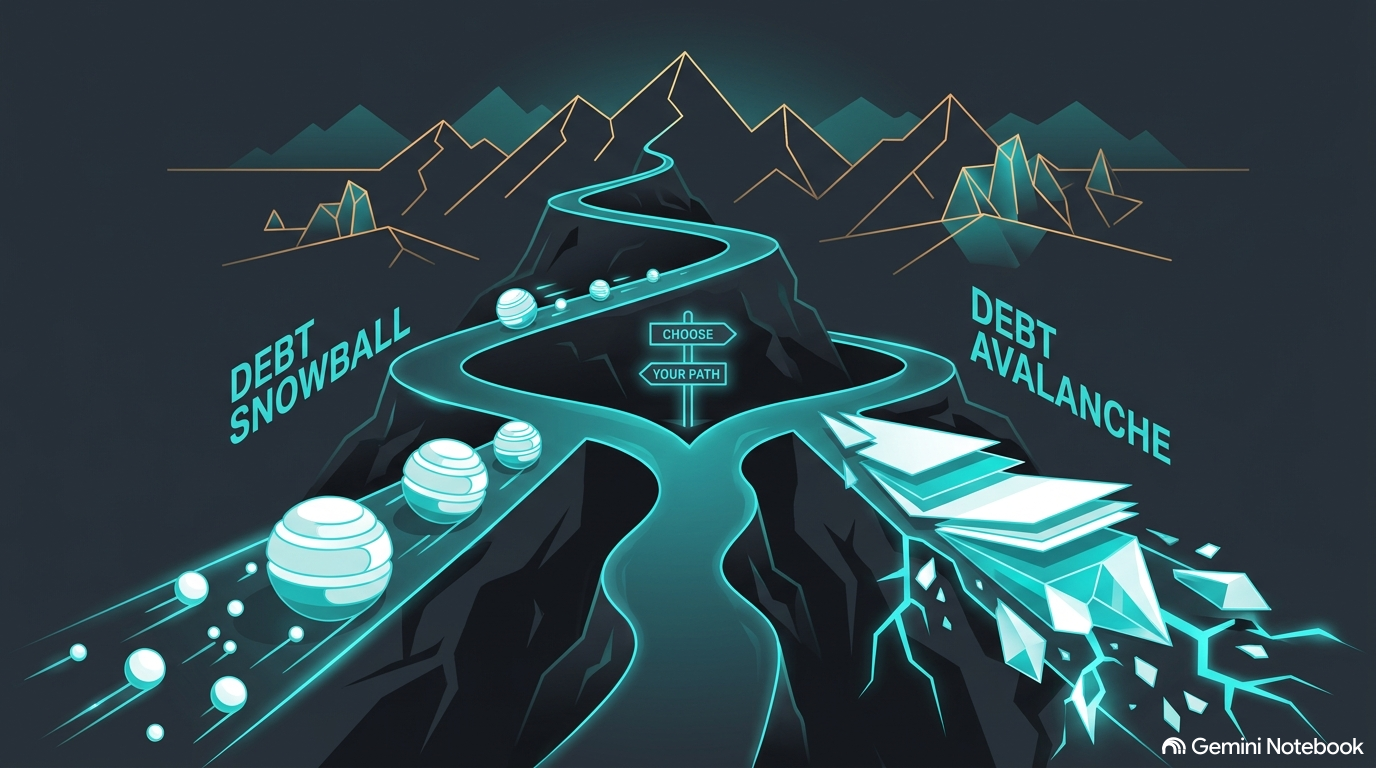
Fortunately, personal finance experts widely agree on two highly effective frameworks for systematic debt elimination: The Debt Avalanche and The Debt Snowball [159, 160].
While both methods require making minimum payments on all your obligations while directing extra cash toward a single target debt, they approach the task from completely different angles [160, 162]. Today, we are going to dive deep into the ultimate comparison of Debt Snowball vs Debt Avalanche to help you determine which approach aligns best with your mindset, psychology, and cash flow goals [160].
Understanding the Common Mechanics of Debt Payoff
Before comparing Debt Snowball vs Debt Avalanche, it is crucial to understand the foundational principle behind systematic debt reduction [161].
When you carry multiple balances across credit cards and personal loans, your monthly payments are split between two components: the Principal (the actual balance you borrowed) and the Interest (the fee charged by the lender, calculated as an Annual Percentage Rate or APR) [161].
When you only make minimum payments, the vast majority of your money goes toward interest charges, keeping you trapped in the compounding loop [161, 194]. To break this cycle, both the Avalanche and Snowball methods use a focused, four-step execution process [162]:
- Step 1: List every single debt you owe, including the total balance, current interest rate (APR), and required minimum monthly payment [162].
- Step 2: Order your list according to the specific rules of your chosen strategy (by interest rate or by balance size) [162].
- Step 3: Set up automatic minimum monthly payments for every debt on your list except the one at the top [162].
- Step 4: Throw every single extra dollar from your budget toward the top target debt until its balance hits zero, then roll that entire payment amount over to attack the next debt [162].
This rolling payment mechanism creates a compounding momentum effect over time, accelerating your progress with every debt you eliminate [163].
  EXTRA CASH FLOW + TARGET MINIMUM PAYMENT
                     |
                     v
             [ ACTIVE TARGET DEBT ] ---> Fully Cleared!
                     |
                     +-- (Entire monthly payment rolls over!)
                     v
             [ NEXT TARGET DEBT ]
Strategy 1: The Debt Avalanche Method (Strict Mathematical Optimization)
The Debt Avalanche strategy is the mathematically optimal path to debt freedom [163]. Its primary objective is simple: minimize the total amount of interest paid to lenders over the lifetime of your debt payoff journey [163].
How the Debt Avalanche Works
Under the Debt Avalanche method, you organize your debts strictly by interest rate (APR), from highest to lowest [163]. You completely ignore the total balance owed on each card or loan [163].
- Identify the debt with the highest interest rate (for example, a store credit card charging 29.99% APR) [164].
- Allocate every extra available dollar in your monthly budget to pay down this high-interest account [164].
- Continue making minimum required payments on all other lower-interest accounts [164].
- Once the highest-interest balance is fully cleared, redirect its entire monthly payment—plus your extra budget funds—toward the debt with the second-highest APR [164].
Real-World Example of the Debt Avalanche
Imagine you have three debts:
- Card A: $8,000 balance at 28% APR (Minimum payment: $200) [165]
- Card B: $2,000 balance at 18% APR (Minimum payment: $50) [165]
- Personal Loan C: $500 balance at 10% APR (Minimum payment: $25) [165]
If you have $300 in extra monthly cash, your target order under the Debt Avalanche is Card A first, because its 28% APR is charging you the most money in interest every single day [165]. Even though Personal Loan C has the smallest balance ($500), it sits at the bottom of your list because its 10% interest rate is much less damaging to your total net worth [165, 166].
- Advantages: Saves the maximum amount of money in compound interest and shortens total payoff time by keeping your payments focused on reducing principal [166].
- Drawbacks: Delayed first win [167]. If your highest interest rate is attached to a large balance (like Card A’s $8,000), it may take several months of consistent payments before you experience the satisfaction of closing an account [167]. This requires high levels of self-discipline [167].
Strategy 2: The Debt Snowball Method (Behavioral Psychology First)
The Debt Snowball strategy turns financial management on its head by prioritizing human psychology over pure mathematics [167]. Pioneer personal finance experts popularized this method because financial success is often driven more by behavior change than mathematical calculations [167].
How the Debt Snowball Works
Under the Debt Snowball method, you organize your debts strictly by total balance size, from smallest to largest [168]. You ignore interest rates entirely [168].
- Identify the account with the smallest dollar balance (regardless of whether its interest rate is 5% or 25%) [168].
- Throw all extra monthly funds at this smallest account until it is fully wiped out [168].
- Make minimum payments on all larger balances [168].
- Once the smallest account reaches zero, take its entire payment amount and add it to the next-smallest balance [168].
Real-World Example of the Debt Snowball
Using the exact same accounts from our previous example:
- Personal Loan C: $500 balance at 10% APR [169]
- Card B: $2,000 balance at 18% APR [169]
- Card A: $8,000 balance at 28% APR [169]
Under the Debt Snowball, your target order flips completely [169]. You target Personal Loan C ($500) first [169].
Because the balance is small, your extra $300 a month (combined with the $25 minimum) will completely destroy this loan in less than two months [169]. Crossing off an entire account so quickly produces an immediate behavioral reinforcement, triggering dopamine responses that keep you engaged and committed to tackling Card B next [169, 170].
- Advantages: Immediate psychological momentum, fast simplification of your finances by reducing the total number of open bills, and a higher success rate for beginners who struggle to stay motivated [170].
- Drawbacks: Costs more in total interest over time and can slightly extend your total payoff duration because high APR balances continue to accumulate interest untouched for longer [171].
Side-by-Side Comparison of Debt Snowball vs Debt Avalanche
To help you visualize the comparison, let’s look at the core differences of Debt Snowball vs Debt Avalanche side-by-side:
| Feature | The Debt Avalanche Method | The Debt Snowball Method |
|---|---|---|
| Primary Focus | Interest Rate (APR) [171] | Balance Size ($) [171] |
| Ordering System | Highest APR to Lowest APR [171] | Smallest Balance to Largest Balance [171] |
| Main Advantage | Maximizes financial savings [171] | Maximizes emotional motivation [171] |
| Time to First Win | Slower (depends on balance size) [171] | Faster (usually within 30–60 days) [171] |
| Total Interest Cost | Lowest overall cost [171] | Higher overall cost [171] |
| Best Mindset | Analytical, disciplined, goal-driven [171] | Reward-driven, persistent, visual [171] |
Mapping the Localization Gaps: US vs. UK Liabilities
When comparing Debt Snowball vs Debt Avalanche on different sides of the Atlantic, the actual products and liabilities have different names, structures, and collection rules:
- 🇺🇸 United States: Typically involves high-interest store cards (such as Kohl’s or Target cards), major bank credit cards, medical copays, auto loans, and federal or private student loans [158, 182, 196].
- 🇬🇧 United Kingdom: Typically features high street store cards, catalogues (flexible credit accounts), major credit card balances, personal bank loans, car finance (PCP/HP), and student loans (which have unique income-contingent repayment thresholds and are rarely consolidated with consumer debt) [182, 196].
Regardless of your location, the math remains identical: ordering by interest rate saves cash, while ordering by balance builds momentum [163, 168].
How to Choose the Strategy That Will Set You Free
Selecting between Debt Snowball vs Debt Avalanche comes down to an honest self-assessment of your personality [172]. Neither method is “wrong”—the best strategy is simply the one you can stick with until your balance reaches zero [172].
Choose the Debt Avalanche If:
- You are comfortable looking at spreadsheets and tracking financial returns [172].
- The thought of paying unnecessary interest charges to banks makes you physically uncomfortable [172].
- You have strong self-discipline and do not need immediate positive reinforcement to stay focused [172].
- Your highest-interest accounts have small or moderate balances that won’t take years to clear [172].
Choose the Debt Snowball If:
- You feel completely overwhelmed by the total number of accounts you have open [173].
- You have tried getting out of debt before but lost momentum after a few months [173].
- You need quick, visible progress to stay motivated [173].
- Your smallest balances can be wiped out within 30 to 90 days [173].
Supercharging Your Repayment Engine
Whichever path of Debt Snowball vs Debt Avalanche you select, you must secure your foundational structure first. Always build a Starter Emergency Savings Buffer of $1,000 / £1,000 before aggressively throwing extra money at debt [175, 194]. Without this cash safety net, any minor emergency will force you to rely on credit cards again, resetting your progress [175, 197].
Once your safety buffer is built, look for ways to unlock extra cash flow. You can use Automatic Round-Ups on your debit card to accumulate small savings on autopilot, then sweep those pools at the end of the month to make an extra micropayment on your target balance [168, 197, 198]!
By combining the structural discipline of Calculating Your Survival Budget with your chosen payoff framework, you will pave a clear, reliable path toward complete financial independence [193, 194].
🛡️ Professional Disclosure & Compliance Framework
⚖️ YMYL Financial Disclaimer
Disclaimer: DebtPave provides free, educational personal finance resources to help you build long-term financial literacy. We are not certified financial planners, registered investment advisors, or legal experts. Always consult with a qualified, registered professional before restructuring your liabilities or signing up for debt relief services.