
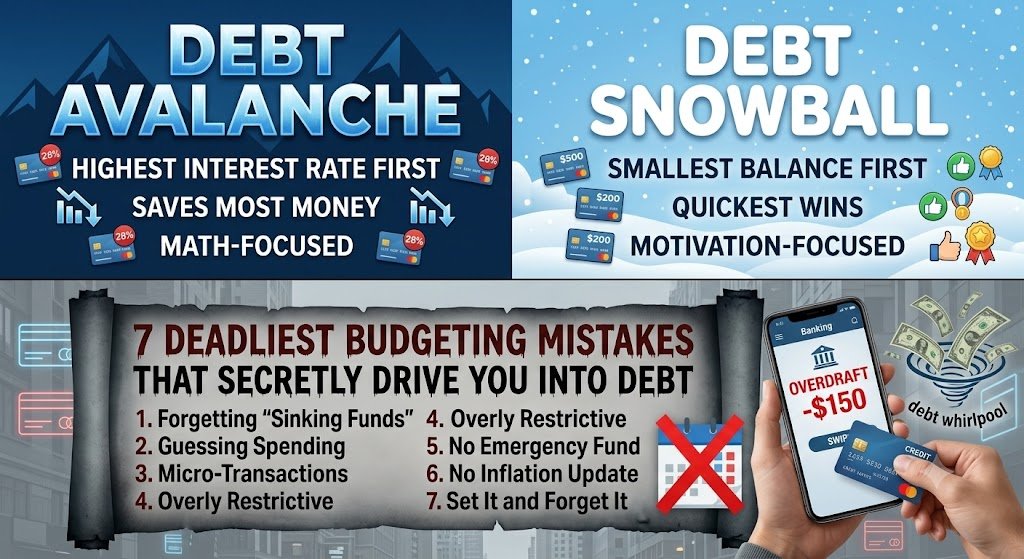
- Introduction: The Hidden Trap of Ineffective Budgeting
- Mistake 1: Forgetting “Sinking Funds” for Irregular Expenses
- Mistake 2: Guessing Your Expenses Instead of Tracking Real Spending
- Mistake 3: Underestimating “Micro-Transactions” and Small Leaks
- Mistake 4: Creating an Overly Restrictive Budget
- Mistake 5: Treating Your Emergency Fund as Optional
- Mistake 6: Failing to Adjust for Inflation and Cost-of-Living Changes
- Mistake 7: Using a “Set-It-and-Forget-It” Mentality
- Frequently Asked Questions (FAQ)
- Final Thoughts
Introduction: The Hidden Trap of Ineffective Budgeting
Creating a monthly budget is widely considered the cornerstone of personal financial success. We are constantly told that if we track our income and expenses, we will naturally save money, build wealth, and stay out of debt.
However, millions of hard-working people create a budget every single month, yet still find themselves relying on high-interest credit cards to make ends meet before their next paycheck arrives.
If you consistently find yourself running out of money before the end of the month—despite having a neat spreadsheet or budgeting app—you are not alone. The problem usually isn’t a lack of effort or willpower; it is structural flaws in how your budget is built.
Traditional budgeting advice often focuses on basic categories like rent, utilities, and groceries while overlooking real-world variables, psychological triggers, and hidden cash leaks.
In this comprehensive guide, we will examine the 7 deadliest budgeting mistakes that quietly undermine your financial progress and provide clear, actionable solutions to fix them for good.
Mistake 1: Forgetting “Sinking Funds” for Irregular Expenses
The Hidden Problem
Most budgets focus exclusively on monthly recurring bills: mortgage/rent, electric bills, internet, and groceries. However, life is full of predictable, non-monthly expenses that disrupt your finances if you fail to plan for them.
Annual car registration fees, quarterly insurance premiums, holiday gift shopping, home maintenance, and Amazon Prime renewals are not surprise emergencies—they are known expenses with clear deadlines. When these bills arrive without a dedicated allocation, people frequently turn to credit cards to bridge the gap.
The Fix: Build Dedicated Sinking Funds
A sinking fund is simply a savings bucket where you set aside a small amount of money every month for a specific future expense.
- Step 1: Audit your past year’s bank statements to list all annual, semi-annual, and seasonal expenses.
- Step 2: Calculate the total annual cost for each item (e.g., $1,200 for holiday gifts and travel).
- Step 3: Divide that total by 12 (e.g., $1,200 / 12 = $100 per month).
- Step 4: Automatically transfer that calculated amount into a dedicated savings account every single month. When the bill arrives, the cash is sitting there waiting for you.
Mistake 2: Guessing Your Expenses Instead of Tracking Real Spending
The Hidden Problem
When creating a budget for the first time, most people write down what they think or hope they spend on variable categories like food, gas, and entertainment.
Unfortunately, human beings are naturally optimistic estimators. You might assume you spend $400 a month on groceries, but a quick review of your bank statements might reveal you actually spend $650 when accounting for quick trips to the corner store or midweek runs for household supplies.
Budgeting based on ideal estimates rather than realistic spending patterns creates a structural deficit before the month even begins.
The Fix: Perform a 30-Day Financial Audit
Stop guessing and track your actual financial footprint:
- Download your bank and credit card statements from the past 30 to 60 days.
- Categorize every single transaction into fixed bills, variable essentials, and discretionary spending.
- Base your new budget limits on your actual historical averages, not an ideal fantasy version of your spending habits.
- Gradually trim target categories down over time rather than making drastic, unrealistic cuts immediately.
Mistake 3: Underestimating “Micro-Transactions” and Small Leaks
The Hidden Problem
When analyzing budget leaks, people naturally look for large, obvious expenses. However, budget failure is rarely caused by a single massive purchase; it is usually caused by the cumulative impact of dozens of small “micro-transactions.”
A $5 daily coffee run, a $12 unused streaming subscription, $8 in convenience store snacks, and frequent $6 food delivery fees do not feel threatening in isolation. However, spread across 30 days, these small purchases quietly drain $200 to $400 out of your checking account every single month—often ending up on a credit card balance.
The Cost of Unnoticed Micro-Transactions
| Daily Small Purchase | Average Unit Cost | Monthly Total | Annual Total Cost |
| Gourmet Coffee / Specialty Drinks | $5.50 | $165.00 | $1,980.00 |
| Food Delivery App Convenience Fees | $7.00 (3x/week) | $84.00 | $1,008.00 |
| Unused Digital Subscriptions | $14.99 (2 apps) | $29.98 | $359.76 |
| Impulse Snacks / Gas Station Runs | $4.00 | $120.00 | $1,440.00 |
| Total Hidden Drain | — | $398.98 / mo | $4,787.76 / yr |
The Fix: Establish a “Miscellaneous” Buffer and Audit Subscriptions
- Cancel all recurring subscriptions and memberships you have not used in the past 30 days.
- Set up a weekly “fun cash” allowance for small daily wants. Once that allocated cash is gone, spending in that category stops until next week.
- Add a dedicated $100 “Miscellaneous” line item in your monthly budget to catch small, unaccounted-for cash slippages without breaking your overall plan.
Mistake 4: Creating an Overly Restrictive Budget
The Hidden Problem
When people decide to get serious about their finances, they often adopt an extreme “frugality mindset.” They strip away all dining out, social activities, hobbies, and personal entertainment from their budget in an effort to save every possible penny.
While this works briefly, extreme restriction usually leads to frugality fatigue. Just like crash dieting often leads to binge eating, a severe, fun-free budget almost always ends in a massive emotional spending spree—frequently charged to a credit card out of frustration.
The Fix: Build Fun Money into Your Plan
Sustainability is key to long-term financial stability:
- Budget for fun explicitly. Allocate a modest, guilt-free spending category every month for entertainment, dining out, or hobbies.
- Treat this personal spending money as a necessary budget line item, not an afterthought.
- Follow the 80/20 Rule: Focus on managing 80% of your income strictly (savings, bills, debt payoff) while allowing 20% flexibility for personal lifestyle enjoyment.
Mistake 5: Treating Your Emergency Fund as Optional
The Hidden Problem
Many people focus all their extra cash on paying down existing debt without maintaining a liquid cash reserve. While paying off debt is a top priority, operating without a cash safety net leaves you vulnerable.
When an inevitable emergency occurs—such as a medical bill, home repair, or car breakdown—you will have no cash available to cover it. As a result, you are forced to use high-interest credit cards, effectively resetting your debt payoff progress and restarting the vicious cycle.
The Fix: Establish a Starter Emergency Fund First
- Pause Aggressive Debt Payoff Temporarily: Before throwing every extra dollar at credit card balances, build a $1,000 starter emergency fund in a separate high-yield savings account.
- Keep Funds Liquid and Accessible: Ensure this cash is completely separated from your everyday checking account so you aren’t tempted to spend it on non-emergencies.
- Expand Over Time: Once your high-interest debt is eliminated, expand this emergency fund to cover 3 to 6 months of living expenses.
Mistake 6: Failing to Adjust for Inflation and Cost-of-Living Changes
The Hidden Problem
Prices for essential goods—groceries, electricity, auto insurance, and gasoline—fluctuate constantly due to market shifts and inflation.
If your budget uses expense figures from two or three years ago, your allocated dollar amounts will consistently fall short of actual costs. Trying to buy $500 worth of today’s groceries with a budget set for 2022 prices creates a built-in deficit that gets pushed onto credit cards.
The Fix: Conduct Quarterly Budget Reviews
- Review your essential line items every three months.
- Adjust your grocery, utility, and fuel categories to match current economic realties.
- If essential bills rise, rebalance your budget by trimming discretionary areas to preserve your savings goals.
Mistake 7: Using a “Set-It-and-Forget-It” Mentality
The Hidden Problem
A budget is not a static document that you create once at the start of the year and leave on a shelf. Treating your budget as a rigid, unchangeable plan leads to frustration the moment real life interferes with your projections.
Unexpected income changes, mid-month bill adjustments, or social invitations happen regularly. If you do not interact with your budget throughout the month, small overspendings in week one will snowball into severe deficits by week four.
The Fix: Adopt a Weekly “Money Minute” Routine
- Schedule Weekly Check-Ins: Spend 10 minutes every Sunday reviewing your recent purchases against your active budget allocations.
- Practice Zero-Based Adjustment: If you overspend on groceries during week two, proactively move funds from your dining out or entertainment category to cover the difference immediately.
- Use Modern Tools: Utilize digital budgeting apps or dynamic spreadsheets that update cash balances automatically across devices.
Frequently Asked Questions (FAQ)
What is the best budgeting framework for beginners?
The 50/30/20 rule is widely regarded as the most effective starting framework. Allocate 50% of your net income to Needs (housing, utilities, food), 30% to Wants (entertainment, lifestyle), and 20% to Financial Goals (debt repayment, savings).
How many bank accounts should I use for budgeting?
A great system uses three accounts:
- Primary Checking: For fixed monthly bills and income deposits.
- Spending Checking: For variable weekly expenses (groceries, fun money).
- High-Yield Savings: Dedicated exclusively to your emergency fund and sinking funds.
Final Thoughts
Budgeting is a practical skill that improves with practice. By eliminating these 7 common mistakes, building sinking funds, and adjusting your numbers realistically, you will turn your monthly budget into an empowering tool that protects your income, keeps you out of debt, and builds long-term wealth.